Tuesday, May 22, 2007

A whining Nation

It is no secret that Moi messed up Kenya. It is equally no secret that Kenyans have acquired a whining mentality-that things are not working well as they ought to.

In the spirit of whining, the civil service has been painted as pathetic and lazy, corrupt and inept. The public has been accused of ignorance and illiteracy.

While the indictment may be true, I guess we should always give room for change. When we ever know the situation is changing if we do not give people a chance, every act is condemned.

Most of the people working in government offices are our mothers, fathers, brothers, sisters and cousins, who probably we hold in very high esteem. These relatives have organised their homes, pushed kids through school with peanut salary and clothed all of us somehow.

I am not in any way condoning the ills that wreck the country but I think its time we gave people a chance.

Change comes from within, we must change our outlook.

Most of the people who whine and trash the government do not queue for its services, don’t visit our hospitals, don’t go to our schools- they have access to the best services.

We may want things to move faster but even Rome was not built in a day. It takes time.

For instance, America took almost a century to make meaningful gains in the fight against child labour and efficiency in government.

We all want an efficient civil service and an informed public but it has to start somewhere.

I always feel good when I visit an office and am served well. Not because it’s a favour but because it reminds me that the situation is not that bad after all. Of course there is room for improvement but for once, stop whining.

Without fear of contradiction, I can say that at times I don’t like the services offered but if you get to know the level of poverty or the residence or salary of the person serving you, I think you say THANK YOU!

Ends

Friday, May 18, 2007

THE DEBATE OF THE YEAR

It was going to be the debate of the year, it was eagerly waited for, and at last Kenyan politicians were expected to address issues.

“I was going to be extremely impressed if they turned up. It would have been the debate of the year,” said Michuki Mwangi.

Probably Michuki’s argument epitomizes the feeling of over 80 people who gathered for the debate. It was going to be a good day.

It has been argued that some of the expected guests may not have been aware of the ICT issues expected to be discussed. Whilst this may be true, the leaders- Balala, Raila, Ruto, Kalonzo, Mudavadi, Nyagah, and Umar were sent a background note outlining the state of ICT in the country.

There was every indication that they would turn up, Ruto and Mudavadi even claimed to be on the way. At the end of it, the wait was too long and we had to proceed with the program.

The function was facilitated by Eng. James Rege and Muriuki Mureithi and all networks within KICTANet were represented.

Joseph Mucheru, Kanja Waruru, Edith Adera and Brian Logwe took turns leading the debate and the participation was equally good.

Though the live stream was hampered by poor PA system, people managed to tune in. it was a first step towards creating local content. Next time KDN and Intersat Africa will provide video streaming.

Thursday, May 17, 2007

POLITICIANS AND ISSUES


It has been said many times that Kenyan politicians need to move beyond petty politics and embrace issues.

So when the so called ODM big wigs were invited to the ICT debate, it was expected that they would for once give a blue print of an ICT enabled country.

Most of those politicians will also be on the frontline of telling you how South Korea has developed than Kenya, yet in 1969, Kenya was perceived to be doing much better.

It was therefore expected that these politicians, who are gunning for Kibaki’s job will do better by demonstrating how Kenya could follow South Korea which by the way is the world’s most wired country.

That the politicians confirmed to participate but withdrew last minute is indicative that they either do not understand the role of ICT in developing the country or they do not care about addressing issues.

Am told that for the politicians, they are only interested in the ignorant voter and not the professionals, who are accused of shouting from roof tops yet do not turn out to vote.

I have heard stories that because Kenya has not built or maintained roads means that the politicians can not hold such a debate or such a debate can’t stream live on the internet.

Such arguments are made by people who are not in touch with reality in Kenya. They would rather stand on high horses and say how the government should do this or that instead of appreciating the simple things.

On a different note, somebody commented on radio how we are always quick to criticize the police yet we do not take time to commend them when they do something nice. They stand in traffic whole day at times rained on yet expected to perform like those in Europe or US.

So, if the comment is to tell me how Kenya is a pathetic country, don’t comment here, am sure there are other blogs that will entertain that, this is only for those who appreciate the small steps the country is taking towards development and change.

Whilst the failure to participate may demonstrate lack of maturity by the politicians, does it mean we are all at that level.

Is there anything that can be done to change politics?

Monday, May 14, 2007

Life in a coffee estate- hard work or exploitation??

There is nothing interesting in a coffee estate but being a young girl or boy growing up in central province, it’s worth it.

As a teenager, the major hurdle is waking up at 4am, one must monitor the lorry moving up before strategically lining up by the roadside and wait for the rope to be lowered down, and the “turn boy” hoists you up.

This marks the beginning of a hectic day.

Rewind!!!!! Why would a teenager go to the estates??

Of course there is nothing good about child labour but the joy of making your own money is overwhelming. For those who don’t have parents to shower them with money and gifts, it feels good to have your own money and the liberty to spend it.

On the other hand, the more money you make, the more you set yourself aside from the other lazy bones.

This was probably one of the reasons why we would walk about five kilometers to a coffee estate just outside the town I grew up. We would gather around every morning and walk there, this happens when there is no transport.

After 5 pm, we gather and compare our money, and vow to do better the following day. To us, it was the formation of the spirit of hard work and competition.

But there is a thin line between child labour, competition and hard work.

There are various reasons why teenagers, not children work in the estates, but when this work is forced and exploited, then it becomes something else.

Just like Bill Clinton delivered newspapers when he was young. If there were any coffee estates in his region, am sure he would have taken the offer.

Get me right, I am not advocating for child labour, I am only looking for the constructive side of it.

So, read on……

Wednesday, May 02, 2007

FIDA: ELITIST OR NOT?

When Keriako Tobiko, advocate of the high court labeled FIDA as “busy bodies”, the statement attracted angry reactions from the feminist movement in Kenya.

Because Tobiko was representing former cabinet minister Julius Sunkuli in a rape case, many saw his remarks as utter disrespect for FIDA.

After all, Tobiko was arguing his client’s case, which was finally withdrawn, and a whole soap opera followed. Am sure you all know the story of how the girl in question appeared on TV after withdrawing the complaint.

In retrospect, Tobiko’s remarks may have had some truth. In the recent past, the role of FIDA has become increasingly questionable.

Though Tobiko is now Director of Public Prosecutions (DPP) and may have toned down his feelings about FIDA, others may not have.

Sample this: FIDA is only heard representing clients when one of the culprits is an MP or a “fat cat”. Does it mean those are the only people suffering?

Of course FIDA will say that the media is biased and does not report those small cases but how many?

As Nekessa put it, there may be many stories of people who have written to FIDA and not gotten responses.

To assess the situation, I had a chat with Jo, my friend who gave the little girl a ride. I sought to know why she did not refer the mother to FIDA.

“FIDA is not for desperate people, its all about big people and big publicity. For me I saw it as a social issue and not a political one like FIDA likes them,” said Jo.

As a lawyer, Jo apologized profusely that she did not see FIDA as a representative of the poor. For her, FIDA is all about show biz and the quest for donor money. In short, the bigger the culprit, the bigger the story.

FIDA will argue that the introduction of fees may be important to sustain the organizations, but the organization moved offices to Lavington, a posh area.

Whether that place is accessible or not, am sure that is not within my province to determine.

It may seem like harsh judgment to FIDA but I called their offices and they promised to call back. Am still waiting.

Back to the question- is FIDA a mere busy body?

Is it there to chase big wigs or is it for the Kenyans with brown teeth and bad breath?

In my opinion, I don’t think so. I have met quite a number of people stranded at the law courts wondering where the FIDA lawyers are, only to be told that the lawyers came and adjourned the cases and left.

Having offices in Lavington is not the best gesture, how many people can access the offices? How far do they walk or are expected to drive??

With the rising cases of rape, violence against women among other crimes in Kenya, one would have expected FIDA to have their strong presence in Naivasha, Kiambu, Nyeri, and Kisumu among many other areas that such crimes are prevalent.

If you do not hear of FIDA in such areas, what do you expect of those silent sufferers who can only write a letter and hope it is followed up?

Be the judge!

Ends

Sunday, April 29, 2007

Changing face of government

The first time, Bitange Ndemo, Information and Communication PS responded to an article I had sent to the KICTANet mailing list, I could not believe it. I thought someone else was doing it on his behalf.

After all, we are used to government officers who follow protocol that even responding to straight forward questions is a problem. Even clarifying issues.

So, for me to read from a PS explaining how I had left out vital points or misconstrued facts was amazing. He did not condemn, only clarified. He also encouraged dialogue, invited list members to ask, and he answered promptly.

Ndemo is now well known by list members and does not wait or give appointments just to explain about the fibre optic cable. He is known to visit forums such as mashada and explain to the youth about issues affecting his ministry.

For a journalist, this is easy, just drop him an email and you are home and dry….

Ndemo may be exceptional because he is trying to promote ICTs but there are other instances where the face of government has changed.

Sample this, during the KICTANet monthly forum, a young man, Robert Ogutu, from the ministry of youth affairs was present to explain about their projects at the ministry. She was accompanied by a colleague who was speaking about reviving the village polytechnics and the inherent challenges.

What was good about the presentations was that both presenters had just a day to make presentations; they worked hard and made it.

They extinguished earlier ideas that civil servants are lazy and will always point to red tape as a reason not to participate in events especially organised by private sector.

In my opinion, this is the kind of country we would like, where government officers freely interact with the public and can participate easily with private sector and civil society and share ideas.

We almost there….

Ends

A mother's agony when rapists strike

“Why is my stomach aching, I am feeling so bad, why mum, why?” Jane asked as she alighted off the vehicle.

Jane is eight; she was raped at the Ngomongo village in Kiambu. On this day, she was being taken back to Kiambu district hospital for further check up.

The mother could not explain to the girl why she was in so much pain. The girl can note even tell whether the pain is in her stomach or in her private parts, it’s too much for her and she looks dazed.

To add to all the trouble, Jane is mentally challenged, after an attack of pneumonia when she was five. According to the mother, her life changed then.

Most of you may not know Ngomongo slums but its somewhere between Kiambu and Zimmerman, beyond Starehe girls centre. That place has quarries, hence the name Ngomongo.

Jane was home that day; she can not fit in normal schools because she is violent and can not concentrate. The mother had ran out of options.

Ran out of options because she has other kids to feed and is a casual laborer, she claimed that Jane had just been kicked out of school the previous week, and had been left home alone.

So, this guy came and asked who was home and Jane responded she was alone. He convinced her to go the maize plantation and the rest is history.

Incidentally it was the mother who heard the screams; she had just rushed back home to check on her. The man was caught in the act, roughed up and taken to Kiambu police station.

When I enquired much about it, she said the man was released and back in the village. She was not very familiar with the legal regime. All that she knew was that she and her daughter were tormented.

The way I met this girl was so funny because I was to meet my friend Jo at KIST, she was coming from her house near Starehe girls, she was taking so long, anyway, she is the kind who says she is around the corner, when she is not even showered, let alone start the car.

So when I started ranting and threatening to take off she said,

“Hold on, am picking up a sick girl,” I thought she was lying but I knew she can’t lie about something like that.

When I saw the girl, I insisted that all my plans could wait for the girl to get to hospital. Because she could not walk, the mother depended on lifts. On this case, she did not know how to get back home.

As Jane alighted, she was now crying aloud, and from the corner of my eye I could see Jo fighting back tears. The mother seemed to have resigned to fate.

Incidentally, Jo is a lawyer and we never thought of referring her to FIDA. But was it because she said she had explored all options? Is it because FIDA is now too elitist?

The story was moving because it would have been my daughter, sister, cousin and it could be me.
Ends

Friday, April 20, 2007

TAKING IT TO RURAL SCHOOLS

By Rebecca Wanjiku

At the heart of Meru district, Eastern province, a dusty road leads to Ruiga girls’ school. It is a typical village school with no power and vehicles to the shopping centre operate only on market days.

To access it, one needs prior information, if it rained; don’t bother visiting because the road is impassable. The school is two kilometers from the road with no public transport.

Imagine this: the school has an integrated system that allows teachers to teach mathematics, chemistry, biology and physics using animated computer graphics and has an integrated system that allows parents to monitor students’ academic and disciplinary progress from the internet.

The imagination can roll on to the classroom where the teachers use LCD projectors in place of black boards and exam past papers are available online. The assignments are forwarded via email and teachers, parents and students are in constant communication.

Well, this is the dream that the headmistress of the school has dared to dream. The school is typical of many village schools but wants to be the pioneer of computer technology in the area.

This school imposes itself as the testimony of the determination by Cyber School Technology Solutions (CSTS) of providing quality educational services to schools in Kenya- whether rural or urban.

With no power and coming from a place where computers are still perceived as myths, CSTS is proving that all students can enjoy world-class teaching aids that enhance the learning environment.

Fatma Bashir, chief marketing officer at CSTS narrated to ICT stakeholders gathered for the KICTANet forum how she has had to teach communities about benefits of computers before embarking on her mission to promote educational packages.

“One time a headmistress of another school blocked us from entering the school because we were introducing ‘bad pictures through the internet’ to the students. I took time to explain to the teachers the benefits of computers in schools, and that we had good intentions,” Bashir told the forum.

CSTS develops teaching resources, aligned to specific syllabi, featuring 3D animations. Each Unit within a Chapter apart from 3D animations contains 2D animations, visuals, charts, experiments and other reference materials required by teachers in a classroom environment.

Today, Ruiga girls’ school has 220 students and 12 teachers. Granted the challenges, the school was ranked 18 out of 79 schools in 2006, up from 33rd position in the district in 2005, and according to Bashir, the students have demonstrated positive index improvement in sciences subjects after using the Digital Science products for barely 6 weeks before the final exams.

This school epitomizes the desire by CSTS to bridge the infrastructure and digital divide and ensure that rural schools enjoy similar opportunities as those enjoyed by urban schools.

Through the electronic teaching aids offered to schools, CSTS hopes to bridge the digital divide between rural and urban schools. This, Bashir argued, will lead to early familiarization with ICT for teachers and students alike.

According to Bashir, CSTS hopes to qualitatively improve learning by conceptualizing more creatively and digitizing learning resources to help educators build better learning interventions.

For the tough science subjects, CSTS hopes to make them fun by introducing new teaching aides in the subjects of Mathematics, Biology, Physics and Chemistry that animate and turn the subjects to life, making it easier to learn and recall.

Standardizing the learning process thereby creating an equal opportunity for success for every student sitting the examination across the board.

Digital Science is a revolutionary teaching aid because by using animated visuals, that brings to life the abstract concepts learning science has been made easier thus more interesting and readily understood by the students.

“The interactivity built into these modules also gives students a feeling of hands-on experience. At the same time, it gives control to the teachers and students as the lessons follow syllabi of specific subjects while pace and explanations can match the level of the student,” said Bashir.

In Physics, interactivity allows students to tweak parameters in situations and literally see how the system responds to the change. In short, the limitations of a school laboratory are overcome. For example, no school lab can show a nuclear reaction, but this is also shown in our modules.

In Chemistry, using the virtual lab, students can conduct potentially hazardous experiments safely and without the expenditure of chemicals. Even dangerous experiments dealing with poisonous gases, etc. can be performed (students are warned adequately in such cases to prevent them from replicating it in reality). They can also repeat experiments over and over until they are familiar with the process in preparation for practical examinations, all this at the click of a button.

In Biology, through animation of complex concepts students get to understand what they are being taught and can thus apply this not only in their lives but also while responding to examination questions. For example a process such as importance of diffusion in the human body, cell division during reproduction etc are visually depicted aiding the understanding and retention process required in the teaching and learning environment.

CSTS has introduced a new technique of teaching mathematics. In Mathematics, when teaching about shapes, the animation shows the shapes in 3 dimension, thus attracting the students to get into the concept and learn it better and with self-interest.

CSTS recognizes the necessity for educating students about HIV / AIDS appropriately and effectively, using the power of multimedia. The organization has developed innovative, original multimedia teaching tools, on CD ROM for HIV / AIDS education for children between the ages of 6 and 18.

The content sophistication increases for higher age groups, covering the nature of viral infections and causes and effects of HIV / AIDS. Because this is a global problem with many mature themes, it is treated in a sensitive and flexible, non-judgmental manner to appeal to persons from different backgrounds.

The lessons are created in a visually attractive style with cartoon characters giving the message in a manner which is easy to understand. This is followed by interactive exercises, quizzes, etc. to reinforce the learning process, evaluate what they have learnt, and show them how this knowledge can be applied in safe behavior to avoid HIV / AIDS.

By Advocating the use of relevant ICT software in education CSTS hopes to improve learning processes of all students in Kenya as well as improve living standards.

Ends

SETTING DIGITAL PACE IN KENYA’S EASTLANDS

By Rebecca Wanjiku

When Dr Bitange Ndemo, Information and Communication Permanent Secretary asked Collin Bruce and his team to visit Eastlands, everybody was eager.

Eager because the PS had sang praises about Kimathi Information Centre (KIC) and how it had used Information Communication Technologies (ICTs) to uplift the lives of the youth in the area.

As the PS and his team snaked through the streets of Maringo, Jerusalem, Bahati and Uhuru, the team of youth at KIC were putting final touches to the presentation. The KIC team is comprised of Catherine Atieno Agallo {21}, Jose Njuki-Imwe Ngunjiri {26} and Lillian Gloria Okumu {28).

Before welcoming the visitors, the KIC team and the volunteers had to ensure that all the work due to the local schools has been delivered and any other pending jobs are finalized. This is their day to show what the youth can do.

The PS has been so impressed by KIC’s digital innovation and integration to the community that every visitor to Ndemo’s office is referred to the centre for examples of how Kenya has embraced ICTs.

Bruce, the World Bank country director was not disappointed at what he saw. He witnessed how the area youth had worked with meager resources to improve living conditions in the area.

“We have received tremendous support from Dr. Ndemo. It has motivated us to keep exploring our potential,” said Ngunjiri.

He was speaking at the Kenya ICT Action Network (KICTANet) monthly forum, where innovators in ICTs showcase their achievements to other industry players as well as the public.

So why was KIC started?

According to Ngunjiri, they teamed up in December 2005 and decided to come up with innovative practical solutions to the problems of unemployed youth in the area. KIC serves Eastland’s community in Kimathi, Bahati, Jerusalem, Maringo and Uhuru.

Apart from unemployment, the youth in the area lack of proper skills to search for jobs, lack job interview skills and some have been unable to secure attachment opportunities after university.

Armed with their findings and suggested solutions, the trio approached Computer for Schools Kenya and the International Development Research Council (IDRC) seeking assistance.

Impressed by the innovation, the two organizations donated 13 computers and agreed that the trio would train and equip the youth and the whole communities in the area.

“I think they have done an excellent job that can be shared with others,” said Edith Adera from IDRC.

Ngunjiri told KICTANet members how that partnership has improved ICT knowledge, reduced crime rate, unemployment and ignorance among the youth.

“We have tried to ensure that the community owns the project, they give collective security and our equipment has never been stolen. The youth who would have been out mugging people is now working behind computers,” Ngunjiri added.

KIC works with neighbouring schools to provide computer services if needed. For instance, at the end of the term, the teachers forward the scores for tallying and grading instead of doing it manually.

“It is now easier and time saving for teachers to grade the students. Once they mark the exams, we send one volunteer to get the data, organise according to instructions then send back to the school. A minimal cost is charged,” said Ngunjiri.

KIC has tried to integrate everybody into the project provided they show interest in learning. Those with skills they can share with others are encouraged to visit the centre and benefit the others.

Working with university graduates, KIC goes beyond ICTs skills and teaches accounting and small business management skills to those aspiring to start businesses.

Other services offered include- research and study centre, library centre through e-learning, data base centre for small business entrepreneurs, security pay point for Kimathi estate, networking centre, web design training for teenagers under the Mtandao Africa initiative.

Out of the activities, the centre raises money to sustain itself and pay minimal wages to the workers. The priority now is to ensure the community fully embraces ICTs before they can pursue profits.

To fulfill their social responsibility, Ngunjiri told KICTANet forum how KIC supports Shelter of Hope Centre- the local children’s home. The home houses sixty orphans in the neighboring Kiambiu slum.

Because the space at KIC is limited, two trainers from the children’s home have been trained with the expectation that they will impart the orphans with ICT knowledge. Every Sunday, have a volunteer from KIC teaches 5 students from the children’s centre on computer packages and any advanced skills needed.

The progress of KIC has not gone unnoticed by the corporate sector, Popote wireless gave thirty volunteers a chance market the company’s products.

The library and research centre expects to train many students and enter competition for international awards including the Bill and Melinda gate Foundation Program.

Ends

STILL WAITING FOR ICT LAW

By Rebecca Wanjiku

It has been a long wait for an ICT Act, and there is no immediate sign that the wait is over. Though the draft policy was presented to the cabinet by Attorney General Amos Wako, it is yet to be published in the Kenya gazette.

If the draft is published in the gazette, then there can be a chance it will be presented to parliament for debate before end of this year.

Though the AG’s office claims to be attending to the bill together with others pending, the challenge is how to harmonize the draft bill to be in tandem with the Communications Act (1998).

Wako’s office is debating whether to come up with a separate ICT Act or to repeal the communications Act to incorporate the draft bill.

Lawyer Paul Mwangi, who has been following developments of the draft policy, says that the AG can come up with a new Act so long as it does not contradict the Communications Act.

“The draft bill can be published and presented to parliament then they can decide whether to enact an ICT Act or to come up with a more comprehensive Act by repealing the Communications Act and,” says Mwangi.

Mwangi argues that the excuses by the AG are about convenience, and nothing substantial. He adds that it is just a matter of codifying the law, and that can come up with another Act and they will still be applicable.

Lawyer Joseph Kihanya agrees that Bills can be debated and passed to repeal Acts in force.

“Why this cannot be done with the Communications Act (1998) I can not tell,” says Kihanya.

Kihanya adds that Telecommunications law demands that the laws be consolidated into one statute. He illustrates this by quoting the UK Communications Act 2003 which was consolidated into one statute that deals with every aspect of ICTs.

The UK Communications Act (2003) deals with issues ranging from regulations, media ownership and control, internet, ecommerce to the relationship between the ministry and the British Broadcasting Corporation.

The UK CA (2003) is divided into parts that exhaust legislation relation to the field for instance, part 5 deals with competition in communications market. Under this part, there are chapters guiding on functions of the ministry according to the law, and media mergers, detailing how they should be carried out.

The Kenya ICT draft bill is a product of the Economic Recovery Strategy for Wealth and Employment Creation (2003-2007) and was developed by the Ministry of Information & Communications in January 2006.

According to the ministry of Information and Communication website, the ICT draft bill is seeking to encourage sustained economic growth and poverty reduction, promote social justice and equity, mainstream gender in national development, empower youth and disadvantaged groups, stimulate investment and innovation in ICT, and achieve universal access.

The draft bill addresses market structure, policy objectives and targets, implementation strategies, universal access, and the institutional framework of information technology (IT), broadcasting, telecommunications, radio frequency spectrum, and postal services.

But some stakeholders in the ICT industry feel that some amendments should be made to the draft before it is presented for debate. Media owners feel that the draft has not adequately addressed their concerns and instead has come up with draconian measures regarding media ownership.

Ends

FOUR CABLE COMPANIES COMPETING FOR KENYA

Its now official, another company- Herakles Telecom LLC has commissioned Tyco to survey the 13,000km East and South African coast.

Herakles awarded the SEACOM marine survey to Tyco Telecommunications of USA. The survey commences the development of the undersea fiber optic network which will provide high capacity bandwidth connectivity between South Africa, Madagascar, Mozambique, Tanzania, Kenya, India and Europe.

In a press statement posted by Victoria Dillon from Tyco and Brian Herlihy from Herakles, it was confirmed that the cable will connect South Africa, Madagascar, Mozambique, Tanzania, Kenya, India and Europe.

SEACOM becomes the fourth entrant to the scene with questions being raised on whether the costs will come down and the time its likely to take before we get the cable.

In February, the government said the cost of international broadband is set to drastically reduce within 18 months after it confirmed it is ready to adopt three different under sea cables provided through various routes.

Bitange Ndemo, Permanent Secretary at the Ministry of Information and Communication said that Kenya was taking a three pronged approach calculated to reduce the cost of international connectivity.

Priority is given to the East African Marine System (Teams) the fibre optic cable link to Fujairah in the UAE.

“The lead arranger will take over the private/public TEAMS project and will be in charge of financial sourcing. We expect to be done within 18 months,” said Ndemo.

Under the Teams agreement, the Kenya Government will have a 40 per cent holding in the project, Etisalat of UAE will hold 20% and the remaining 40% will go to investors in the East African region. The Government has said it will organise an Initial Public Offer (IPO) on the Kenyan Stock Exchange.

According to John Waweru, Director General at the Communication Commission of Kenya, the Teams project is expected to recover the costs within three years.

Kenya is still pursuing the controversial East African Submarine Cable System (EASSy) an initiative aimed at constructing and operating a submarine fiber optic cable along the East African Coast. EASSy will connect nine coastal countries and island nations and to the rest of the world. The route will be from South Africa to Port Sudan, covering over 9,000 km, connecting Djibouti, Kenya, Madagascar, Mozambique, Somalia, South Africa, Sudan and Tanzania (including Zanzibar).

Thirty-two leading telecommunications operators from East and Southern Africa signed a Memorandum of Understanding (MOU) in December 2003 to carry out the construction and maintenance of EASSy.

But the project was dogged by controversy over whether NEPAD should take the overall leadership or the leadership should be led by the private sector. Terrestrial backbone networks are also being built in separate developments to link all capitals and major cities in Eastern and Southern Africa to the EASSy cable and the international backbone system.

The third international fibre project is fronted by Kenya Data Network (KDN) and which has now signed its contract with Flag Telecom. KDN will link from Mombasa and terminate in an undersea junction in international waters off of the Yemen.

KDN says the link will be fully operational in the first quarter of 2008, just 15 months away. KDN also stresses that its landing station at Mombasa will allow other carriers to co-locate therefore charging only electricity and services at cost.

According to the PS, the three options are meant to make Kenya competitive in provision of international broadband. Ndemo underscored the need for the country to compete internationally and attract international businesses.

He argued that the broadband purchased by international businessmen at a cost of USD 200 costs USD 7,500 in Kenya, therefore ruling the country out as an internet investment destination.

SEACOM now gives industry players a chance to evaluate whether any of the operators will lay the cable, then the debate can start over its efficacy.

Ends

Wednesday, February 07, 2007

Yote yawezekana na ICT….

In 1982, Kenya was holding a major conference seeking to bridge the missing link in telephone connectivity. Twenty five years down the line, another major conference- seeking to bridge the digital divide between the rural and urban areas.

The ongoing expo, dubbed “ICTs for Development”, is bringing together people from all sectors and is geared towards improving connectivity and business prospects in rural areas.

Information and Communication minister Mutahi Kagwe presided over the opening ceremony and reiterated the government’s commitment to improve connectivity and boost business prospects in both rural and urban areas.

To underline the government’s commitment, Kagwe pointed at the fast tracking of multiple Optic Fibre Cable (OFC) i.e. TEAMS, EASSy and FLAG.

The minister promised to speed up implementation of the ICT policy though the draft bill is yet to be published in the Kenya Gazette.

Regarding telephone connectivity, the ministry wants to raise the number of users from the current 7.5 m lines to 23 million and raise the number of internet users from the current 1.5 million to 5 million.

He commended the print media for highlighting ICTs issues but argued that the media could even play a bigger role.

The ministry is organizing an ICT road show that will visit all major towns in the country, and the 210 constituencies.

While the minister was quick to challenge the private sector to demystify e-commerce to ordinary men and women, he forgot to mention lack of proper legislation would hamper e-commerce in the country.

As the private sector explains about e-commerce as the vehicle to economic recovery, there is need to explain that the same government that is touting ICTs as the savior to our economy is the same government that is dragging its feet on legislation. Whether it is the Attorney General’s responsibility or the ministry’s the public assumes they all sing from the same hymn book and they all appreciate the role of ICTs.

Yes, yote yawezekana na ICTs!
Ends

Adopting schools

Adopting schools

It all started with “Adopt a light”, an ambitious city lighting project. Now, Manu Chandaria, industrialist cum philanthropist wants to apply the same concept in ICTs.

Speaking at the ICT for Development opening ceremony, Chandaria challenged Kenyans to adopt schools and make sure they can access computers.

“You can change the face of your village school. Just go there and donate a computer. You can change the face of Kenya,” Chandaria said.

He also disclosed that he will finance a digital training centre in Mariakani. The centre will be expected to act as a base to establish digital villages in coastal area. One digital village will cost approximately shs 140,000 (USD 2000).

Tuesday, February 06, 2007

When surfers misunderstand!!

There is always a temptation to ignore comments made by people but for the sake of completing the communication process, I choose to respond.

True, this is a blog, and bearing in mind the blogosphere is a new component in our lives, there is always a chance one may not understand the meaning and intentions of the writer.

But this blog is not any different from the articles that you read in the papers, only that some articles maybe subjective, because they are my opinion, but aren’t all articles subjective? Anyway, that’s discussion for another day.

I am particularly responding to someone who demonstrated a masterly of ignorance when leaving a comment thus “do you ever find male journalists writing about women?” I can only say the writer has not been reading newspapers.

Forget about blog articles, recall the article by Gakiha Weru, then at the Nation, about seven years ago, detailing his experiences in the hands of a witchdoctor??? That article gave some us a preview of what happens in that room. It would be ignorant of anyone to say, “do women write about witchdoctors?” that would be simply myopic.

The role of a journalist is that of a gatekeeper, telling /warning of what is happening. You may wonder whether they have a right to, but that’s the profession, just like lawyers!

Journalists also set the agenda, they determine what you discuss when you sit at the dinner table. Ever wondered why Kenyan eat, think, drink politics? It’s because, everyday, all headlines are about politics!

So do you think journalists are valuable? Bob Mugabe summed it up when he said newspapers are only good for blowing our noses and wiping our bottoms!!!!
I don’t know what he says about internet.

Then there were pieces about my intentions to visit a gay pub in Brazil, so there is this friend who smsed me and told me he can guess what kind of person I am, then I thought, does he think am of loose morals or am gay? I never sought to know because it was clear this guy did not understand the working of a journalist.

Whether you agree or not, the job sends us to various places that many people may not agree with. But people have a right to know, many Kenyans will die without visiting Brazil, it’s only fair if they can read other sides except the football and samba.

It sounds like a long defensive piece but the upshot of it is that, next time I am in Greece, will make sure I visit the sorority house, next time am in Germany, I will get closer to a skin head and know how they think, that is without endangering my life. I don’t want to be a heroine!!

Next month I am in Lisbon, will tell you much of what you don’t see in the National Geographic!!!

Tuesday, January 16, 2007

WOMEN, MONEY AND ARROGANCE

One day some guy told me that women should not work because when they get money, it gets to their heads and the get arrogant. I felt insulted and actually accused this guy of being stuck in mediaeval, stone age (insert your own insult here), of being cheap and myopic.

But listening to Bishop Wanjiru insult the poor husband, who am told is an excellent cobbler, I was left niggling with the idea and thinking I was unfair to the guy who said money gets to our heads. People have their various party lines and have reasons why Wanjiru should of should not have reacted that way.

Ofcouse it is wrong to generalise about women but it has been argued that women who have money are big headed and have no time for small time niggling husbands.

But is it about money or is it about knowing their rights and stamping their authority?

Wanjiru will in the coming weeks be sacrificed as the devil personified. The question is, if Wanjiru was a man, would she have elicited the same level of criticism?

Wednesday, January 10, 2007

The chewing loverboy

I could only smile while I entered the Grand Regency hotel, one because I knew what I was up to and secondly because I met people who I knew would never guess my mission.

It was the venue I was meeting this dude, who I had called and presented myself as a very wealth but lonely and my only interest was a nice guy who could be my companion. I had made the call and demonstrated how well am doing but little did the poor dude know, my handbag was not padded by wands of cash, hard or plastic.

Once in a while I go to the hotel and that day I had strategically said we meet at 4pm, at that time, I would not expect him to ask for beer. Besides, we barely know each other so hold your horses!

The dude had described himself and there was no difficulty in identifying him. But the story got a different twist when a friend of mine who is a bishop came, he knows me and knows am single and of course knows am ready to mingle. The only problem is that the dude was like 23 and was chewing like a stupid monkey!

God! The chewing irritated me!

Anyway, the dude tells me how he is in campus has no money blablabla and all the mumble jumble psycho bubble about how he is nice and loving but ca not get a decent girlfriend. And I was like “dah… booo…haa… get a life”.

I also poured my heart, how I have this UN job that keeps me late and I can’t get a man to fulfil all my needs. In the meantime I am pinching myself as I tell him that he can actually use my car or even move to my house in kilimani. He had no driving skills so he had to learn how to drive then come use my car.

To my surprise, he said he can’t raise shs 8k for driving, and I thought, “you must be a starter” he suggested I raise the money but I insisted he had to do it as his contribution. He promised to talk to his relatives, raise some little money, and then I would top up. I agreed.

Of course he made me aware of how he can make me happy, do things never done before and I smiled and cheered him on…saying I cant wait……. We parted ways near city market where I was going to buy some fish. We agreed he would meet the following day, so I can top up the money.

Because I was using a newly acquired cell number, I donated to some street boy who was standing near city market on my way out.

I was smiling all the way……

Of young men and old women (1)

I must say that I was not expecting the kind of reaction when I told my friend that I have been working on an “under cover” piece on young male gold diggers.

I was surprised when she thought that I should go ahead and publish the piece! I thought she would rebuff the idea, but she just laughed and told me how true it is.

I got the courage to press ahead because I recall that six years ago, we read the Saturday magazine and get mesmerised by the superlatives that people use to describe themselves.
“Who would not get married to such a person, with all those qualities?” I wondered.

That time, the column was known as lonely hearts, now it’s known as soul mates and is far more serious and am sure has resulted in many marriages.

The column has also evolved to include jokers and those longing for make believe life as espoused in movies and the much aped western lifestyle.

It has included the young men who feel that they can also be maintained just like some women do. Simply gold digging, look for a woman with money and yours shall be a case of emotional satisfaction!!! I agree, the reverse has for a long time been the case.

I must admit that I have no objection to men enjoying the sweat of a woman because I know that women do the same, after all, it’s a free world and we have for a long time demanded equity and equality.

In as much as I may sound biased because of my biology, it should represent a woman’s perspective.

part 2 coming

Friday, December 08, 2006

transvestites vs good hotel

coming to Brasil was to make sure i come out with an experience at the gay pub or street or whateve.
leaving on friday meant that i could go only on thursaday and witness the night life in SP.
Am not so much of a party animal and was wondering how i was going to rush through the nite.
but when we visited Beth, she invited us to dinner on thursday and i was torn in between.
Beth is a gracious lady and probably what i want to be when i grow up. Intelligent, she cheks her diet, dresses well and is ever elegant.
Lidia, he daughter, takes after her. Impressive!!

so i decided to go out to dinner and guess what, the best hotel in town.... nice food...tasty.
i would not however recommend it to my brother who thinks food is all about quantity not quality.

this hotel, i cant even remeber its name but its got a high ceiling making the room airly and the ambience perfect.

so, i enjoyed good food and good company, cant imagine hanging out at the gay pub and missing such an important dinner!!!

Thursday, December 07, 2006

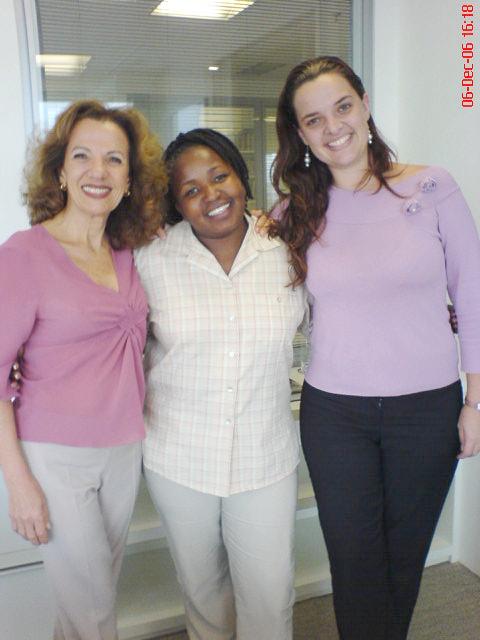
claudia and becky


courtesy of Claudia, i enjoyed nice brazilian dish of pork, bacon and black beans, what in kikuyu we call `wairimu beans` rice and sukuma wiki though they have a local name for the sukuma.
the food was fantastic!!!

corinthians neighbourhood


SP is a football rich city, with current brazil champions Sao Paulo, Pele´s former club santos and now corinthians. in deed today, Ze Roberto (bayern Munich) was on TV donating stuff at Santos, i did not know the guy is a preacher too......
i remember Roberto Carlos was quoted saying that if he retires from Madrid, he can only play for santos.....

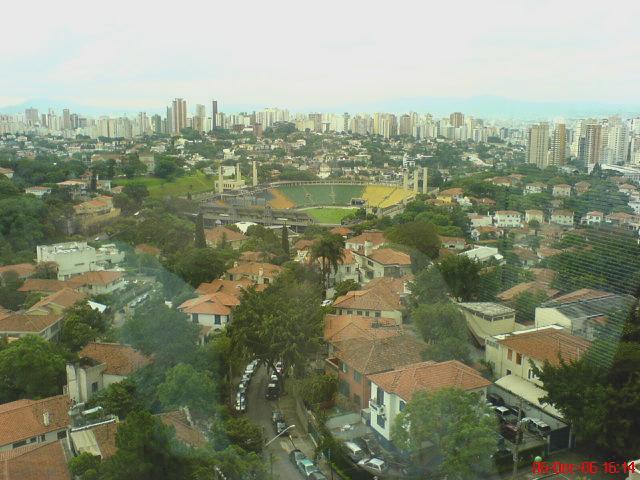
Corinthians FC


am not sure the stadium is well visible but thats where Edu, formerly of Arsenal now with Valencia, was playing. He was `discovered`by wenger in one of his many trips just like he found George Weah, Kolo Toure, Eboue and the like.

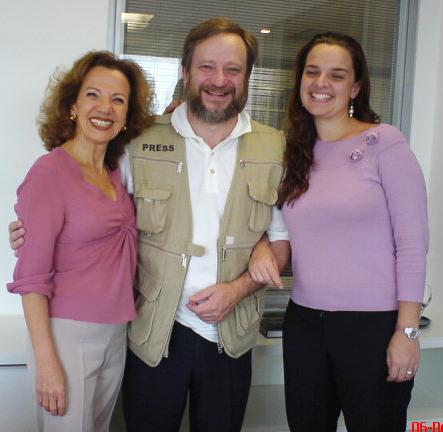
beth, steve and lidia


by the time steve left SP 25 years ago, lidia was a toddler...... now shes married!!!

beth, becky and lidia


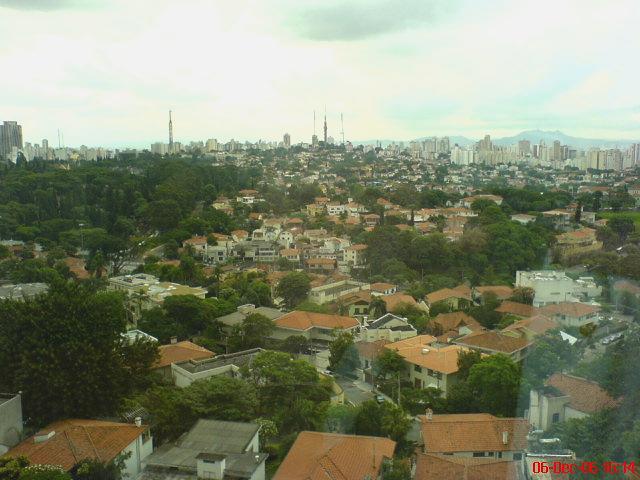
i was happy to meet Beth and Lidia, from their office, i had a nice view of the Corinthians football club stadium


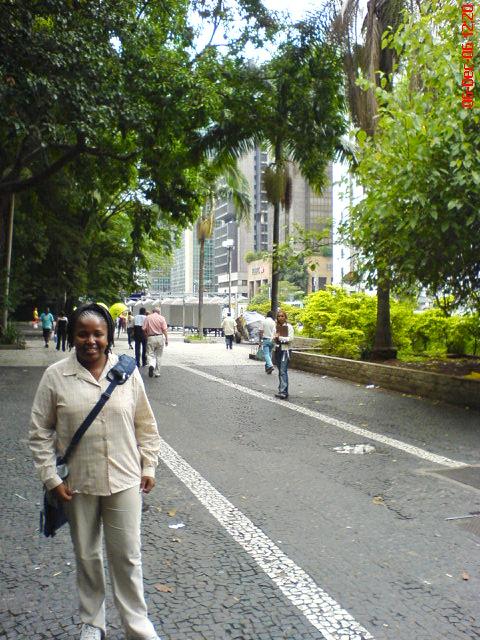
Steve was excited to meet the gal, playboy gal. the men on the streets were amused to see me take the pix. am sure they knew we are africans and there is no playboy here. atleast not in kenya.


at Avenue Paulista. One of the famous places. Thats where most of that banks are.

TANZANIA ENJOYS FRUITS OF CO-OPERATION

By Rebecca Wanjiku,

When Peter Ulanga was invited to visit Brazil, last year, he knew that something was going to change in the management of dot Tz country code Top Level Domain (ccTLD).

Ulanga, and a colleague, Peter Shilla, benefited from training offered by the Brazilian government on management of domain name registries using open source software.

Within two years of the training, Tanzania Communications Regulatory Authority is ready to launch the dot Tz ccTLD registry. The domain has been administered by the University of Dar es Salaam and individuals.

`The training worked well, we have bought necessary equipment and we are ready to launch Tanzania Network Information Centre, TzNIC,` said Ulanga.

Ulanga says that the training was useful and the tests were successful. He added that it will now be easier to register domains and if there are any problems, then there is a central point to channel complaints.
Tanzania benefitted from the south/south solidarity spearheaded by the South American power house. Kenya was the first to train on how to use the software, Tanzania soon followed suit, while Mozambique and Sudan are lining up for the services.
The gesture by the Brazilian government was calculated to ensure that Africa can access the less costly open source software solutions and transform African registries from manual to automation.
At the on-going Internet Corporation for Assigned Names and Numbers(ICANN) conference, in Sao Paulo, renowned Brazilian Professor Hartmut Glaser could not hide his joy while confirming that he had been invited by the Tanzanian government to witness the fruits of his government´s generosity.
Apart from the training, Brazil offered technical assistance to the recipient countries in case of any problems with the software or even any technical hitches in their operations.
The drive to foster south/south cooperation started in 2002 when Brazil sent engineers to Togo to train local counterparts from more than 20 countries gathered in Lome.
Ends


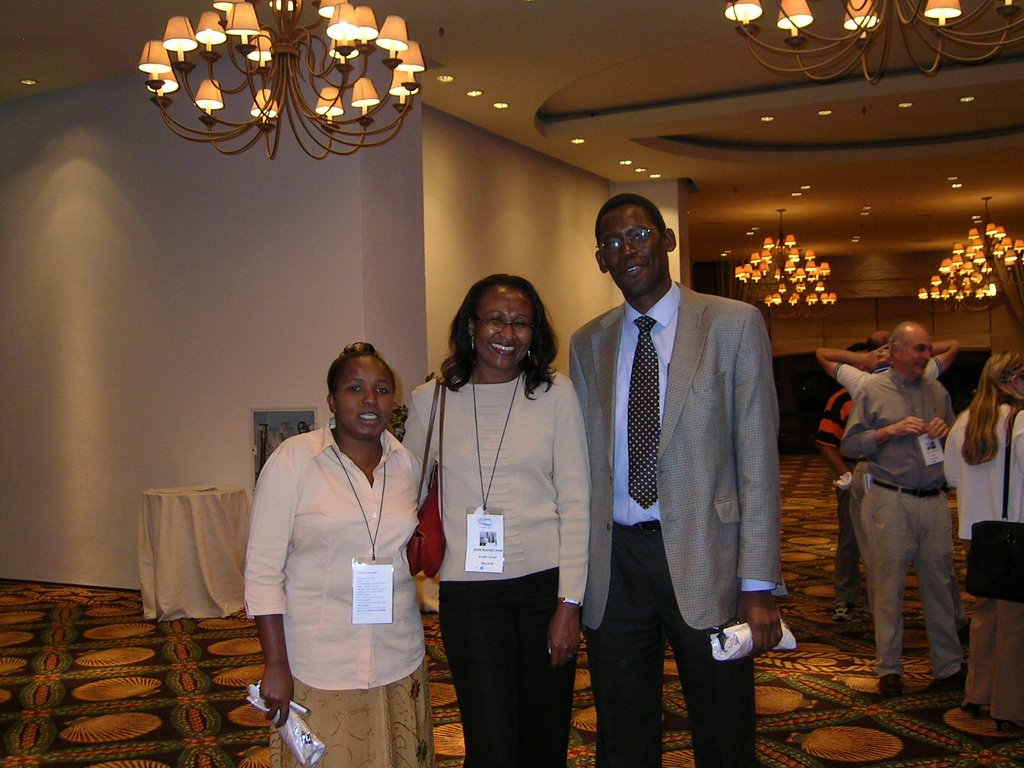
Ann Rachel and Peter Ulanga from Niger and Tanzania respectively. Rachel was instrumental in AFriNIC formation. she is my big sister

Finding Unity in Diversity

By Rebecca Wanjiku
African participants at Internet Corporation for Assigned Names and Numbers(ICANN) meeting in Sao Paulo have formed a unified body that with articulate issues from participants drawn from various sectors.

Africa Regional At Large Organisation (AFRALO) will unite users wishing to articulate their issues to ICANN. AFRALO is expected to link Africa to the global At Large Organisation within ICANN.

Alice Munyua, a member of ICANN´s At Large Organisation says AFRALO will help Africa identify their peculiar issues and call attention to the global body.

¨Through the regional body, African users can identify their challenges and design ways to deal with them. For instance, if the fibre optic cable is laid, then more people can access the internet and then we can deal with other problems other than access,¨said Munyua.

With the growing mobile telephony and cutting edge technology that provides internet via mobile, Munyua says AFRALO will ensure that African voices are heard.

Though not officially launched, preparations of a Memorandum of Understanding are in top gear.

AFRALO is expected to face challenges of language and culture, multiplicity and diversity of digital challenges. Some countries are deemed to have developed ICT infrastructure while others have not.

Munyua expects all countries to meet and point out issues that affect all sectors and the changes they would like to see. The country representatives/ liasons will forward to AFRALO which will then link with the global body.

She recognises that it will be hard to reach consensus because of the diverse interests but she promises AFRALO will work hard to adequately represent african users.
Latin America and the Caribbean have already formed LAC-RALO ( Latin America and the Caribbean Regional At-Large Organisation) which is expected to maximize participation of user groups from the region
Paul Twomey ICANN president, told delegates during the opening ceremony that LAC-RALO will be the third Latin American organisation to help ICANN in its work. The other two are LACTLD (Regional ccTLD managers) and LACNIC (Regional Internet Registry for Latin America ).
Ends

in mar del plata, argentina


celebrating AFriNIC launch at the coastal city. Team Africa was very delighted.

Calling African Scholars

By Rebecca Wanjiku

African scholars interested in developing and preserving indigenous languages have been challenged to take the lead in the Internationalised Domain Name (IDN) debate.


Prof. Maxime Z. Somé, from the University of Ouagadougou in Burkina Faso called on African linguists to actively participate in the IDN project.

`Scientists and scholars should constitute themselves as an exceptional authority in African affairs and move the project forward, said Some.

Some is concerned that Cambodia, Japan, China, Korea and Arabic countries seem to be moving at a faster pace and leaving Africa behind.

In his opinion, linguistic experts as well as scientists in Africa should work together and move the agenda forward. He added that the IDN project requires linguists to agree on the language and terminologies of a particular language and the scientists to work on the technological aspects.

After the agreement of the scripts and language tables, the UNICODE consortium, which consists of computer makers and other bodies, will be expected to integrate the languages into most computers sold to the Africa region.

In this regard, if I have a computer, I can choose the language to use, just like I select to use French or German. In the case of French, the computer inserts the right accents and other letters that may not be available in the English key board.

Asked whether this will lead to development of many key boards, Some says experts can work on some regional languages like Bambara, used in Guinea, Mali, Ivory Coast and Burkina Faso or Fulani, used in Nigeria, Senegal, Mauritania and Mali.

`We know that this project requires a lot of financial commitment and big businesses are not going to invest if not assured of profits. That leaves governments, which have been very non committal, ` he adds.

But he maintains that scholars can jumpstart the process by learning from other countries where experts volunteered their services for the sake of development.

Some spoke at the ongoing Internet Corporation for Assigned Names and
Numbers (ICANN) meeting in Sao Paulo, where the urgency of IDNs has taken
centre stage and its proponents are touting it as a solution to communication problems.

While there are workshops and follow-up meetings to discuss and update on issues relating to IDNs, Africa is stuck with the obsession of listing its numerous cultural and logistical problems as the hindrance to IDN progress.

In 2004, Adama Samassekou, head of the African Academy of Languages was quoted saying there was lethargy within African leadership to use local languages even at Africa Unity meetings Swahili was recommended in 1986
but was used at the AU meeting in July 2004. Swahili is widely spoken in 15
East and Central African countries.
Ends

Wednesday, December 06, 2006


outside Tom Brasil.....

at Tom Brasil theatre in SP


this is where i attended a live show by two Brazilian muscians. apparently there was no much Samba, contrary to popular belif that Brazil equals Samba. theres plenty. i enjoyed.

Loving yourself

spending a night at J´burg international airport is not one of the best thing except if you are booked at the Intercon.

i think the best is the massage palour, it has whats called ``aqua massage``. your body sprayed with water as you lie down.

not naked of course and not like those dingy joints in down town Nairobi where massage can be misataken for other things but pure massage.

its done in full view, though you have to enter into the machine that dispenses water and the whole ceremony begins.

there is also massage on the chair which is also good. so if you are stuck at the airport, make sure you have extra rands.

Loving yourself

spending a night at J´burg international airport is not one of the best thing except if you are booked at the Intercon.

i think the best is the massage palour, it has whats called ``aqua massage``. your body sprayed with water as you lie down.

not naked of course and not like those dingy joints in down town Nairobi where massage can be misataken for other things but pure massage.

its done in full view, though you have to enter into the machine that dispenses water and the whole ceremony begins.

there is also massage on the chair which is also good. so if you are stuck at the airport, make sure you have extra rands.

Tech Challenges

hey guys,
i have been unable to blog coz my blog had been hijacked by some Ghanians, so anything i posted went to their site.
but its ok now....
read on...

almost

hnnnhnhnhnh

Friday, December 01, 2006

The law is truly an ass

today the high court dismissed a case filed by a small girl seeking to strike out sections of the children's Act.

the girl, wanted the court to find that children born out of wedlock had a right to be supported by the father.

what the act does is oppressive to woimen because it places the burden of bringing up a kid born out of wedlock on women.

the court had been urged to make an order that the provisions favors kids in a family set up and discriminates aganist those out of wedlock. in case of divorce, a kid can compel the further to support but in case of illegitimate children......nothing.

high court judges Joseph Nyamu and Mohammed Ibrahim ruled that to strike out the provisions would be retrogressive and unforgivable.....

so you can forgive a father who adsonds his responsibility and heaps it on the mother...... truly an ass.....

Wednesday, November 29, 2006

transvestites in Brazil

am in Sao Paulo next and three of my friends have informed me that there are many transvestites. so, Jemo told me that everyman i see darting me is not necessarily a man, could be a woman dressed as a man and the reverse could be the case.

so, i will have time to write on the young men and my experiences in Brazil. i will make sure i visit night spots as well as the home of Pele, the great footballer!!!

i will be attending the Internet Corporation for Assigned names and Numbers ICANN international meeting.

so i will have more time to spare...... and get you the details....

Tuesday, November 28, 2006

young men who just want rich women

am sure you have all seen adverts in the "soul mate" column where young men just want rich women for sex and money.
well, hang on for my experiences with these yong men!!!
its provoking and funny!!

Monday, September 25, 2006

JOURNALISM TODAY

Today was the first hearing day of the murder case aganist Thomas Cholmondeley, the grandson of colonial settler Lord Delamere.

He is accussed of murdering Robert Njoya, a stonemason who was poaching animals in the expansive farm.

At the court room, one could not help notice the sharp differences between local and international journalists.

When the court adjourned, the local journalists could be ssen in one side, where the director of public prosecutions Keriako Tobiko was, while the international journalists were interested in the defense case.

The stories written reflect the same, the international press reflecting Njoya as a thug who attacked a poor settler. the local press also labours to present the rancher as a heartless and emotionless murderer.

while the local press quotes from another murder of Ole Sisina by the same rancher, the international press goes to great depths to explain the "he was attacked with a panga, like the ones used to kill during civil wars"

So much fo the so called objectivity in journalism.

Friday, September 22, 2006

THE ROCKY ROAD TO THIRD GSM MOBILE PROVIDER

BY REBECCA WANJIKU
Third Global Mobile Service (GSM) is now ready for roll out after Communications Commission of Kenya (CCK) and Econet wireless won the latest legal battle seeking to delay the process until monetary issues are sorted out.
High court judge Mary Kasango struck out a suit filed by Kenya National Federation of Cooperatives Limited on a technicality. KNFC was seeking the court’s indulgence in its effort to avoid the month’s notice required before the suit can be filed. The procedure is prescribed under the Communications Act (1998).
Justice Kasango ruled that the law does not allow her to waive notice adding that the constitution allows her to be guided by written laws. She also declined to exrcise the inherent jurisdiction because such powers only exist where the law is not written or is unclear.
“KNFC finds itself without a leg to stand on. It can not obtain a waiver since the Act does not provide for such waiver. The court’s inherent powers can not salvage the situation,” justice Kasango found.
The Federation moved to court under a certificate of urgency seeking to block CCK from issuing frequencies and other technical fulfilments that were agreed under the licence.
The licence was awarded to KNFC together with its partners, Econet Wireless Kenya, Econet Wireless International Limited and Corporate Africa Limited in 2003 but the consortium has faced a rocky union because KNFC could not raise its required financial quota.
Justice Kasango was ruling on a preliminary objection raised by CCK contending that the court had no powers to issue any orders based on the papers filed by the Federation.
Lawyer Walter Amoko representing CCK told justice Kasango that the Communications Act provides for a period of six months within which an aggrieved party is expected to lodge the dispute. He argued that the Federation had slept on its rights for two years before filing the suit.
Lawyer Njoroge Regeru representing Econet told justice Kasango that the Federation had failed to disclose that there were other proceedings that had been argued before high court judge Mohammed Ibrahim. The consortium was invoved in a protracted legal tussle over shareholding but the case was decided against KNFC. The Federation has filed its appeal.
When the Federation was supposed to present its case on why the suit should be sustained, the lawyer, C.N Kihara did not appear at the appointed time. He only turned up after the judge had waited for half an hour and closed the proceedings of that day. The case was therefore based on the arguments presented by CCK and Econet.
Ends

OF YOUNG AFRICAN GIRLS AND OLD WHITE MEN

It all started at a salon in Dar Es Salaam TZ, a Kenyan gal entered together with her “lover” who wanted her to have her hair done. The gal spoke with a strong Kenyan accent and the gals directed her to her “sister”. I had a chat with her and wanted to know where in Kenya she comes from, and she said; “coast”. Of course I could tell her kikuyu accent.

Being a kikuyu and with lots of prejudice as you can read, I enquired how I can hook up with an old white man who can take me places and pamper me as she had. She had gone on and on about the places she had been on holiday, courtesy of the white guy. We were all in laughter as we sought to know how they hooked up; it was all brewed over the internet!

The Internet!! We all said in unison maybe marvelling at the exploits of technology. We also bitched about how Kenyan girls are good at taking advantage of opportunities coming their way. I must say that is true. But the Internet has only provided us with a new realm.

So much for the Dar incident but my day of reckoning was to come.

At a shopping mall in Luxembourg, I had accompanied HANA editor Steve Lang for the ICANN meeting. We wanted to have lunch but we could not agree. He wanted Japanese salad and I wanted a taste of Thai.

You see, am used to Nairobi shopping malls where you buy food anywhere and sit anywhere in the food court. Not in Luxembourg! If you buy Japanese, sit at their space and Thai has its space. But we wanted to sit together.

So when I went to buy my food, the gal at the sushi bar told Steve, “tell your wife she can sit with you”. So Steve called me and we sat. When leaving, he told me what the gal had said.

And I wondered, how could she think of that, but then I thought that is what we are known for. But I have no intention of hooking up with a pensioner.

So much for the trophy wives.

Thursday, September 14, 2006

Wednesday, September 13, 2006

REBECCA WANJIKU'S BLOG

DEFYING MYTHS
BY REBECCA WANJIKU

African journalism is contributing to development and the situation will improve if journalists overcome myths and obstacles, said Highway Africa Director, Chris Kabwato.

In his welcome address, Kabwato drew an analogy with the Greek mythological figure Icarus who is famous for flying closer to the sun and his artificial wings melted.

Welcoming more than 500 journalists from 42 countries Kabwato said it was possible for African journalists to break the myths that dictate how issues should be covered and represented through media.

“Let us all defy the Greek mythology and fly closer to the sun than Icarus. Let us dare to challenge the economic policies and issues of democracy in our countries. Let us shake the fundamental myths and transform the way we do journalism,” said Highway Africa Director, Chris Kabwato.

Kabwato underscored Highway Africa’s commitment to training of African journalists on ICTs, research, information provision and the conference which offers networking opportunities for media practitioners.

Prof. Guy Berger, Head of the school of journalism and Media studies at Rhodes University said that in the last ten years, African journalism has overcome a lot and the progress is encouraging.

“Ten years ago the internet was barely known. Right now we can talk of the digital divide and the differences in access between rural and urban areas. We are a movement, a community, and an incubator for ideas waiting development,” said Berger.

While emphasizing the need to learn and embrace new technology, Berger said that Highway Africa is not an engineering school but seeks to empower journalists to communicate using ICTs.

The ICT tools, Berger added, should be used in the context of other pressing issues such as economic policies, culture and peculiar circumstances that a country maybe facing.

“There is passion in what we are trying to do. HA is ten years old and in the upcoming teenage years, there will be excitement and lots of experiments,” Berger concluded.
Ends

REBECCA WANJIKU'S BLOG

AFRICAN GOVERNMENTS PUT ON NOTICE

By Kezio-Musoke David and Rebecca Wanjiku

African governments who gag investigative journalists have been put on notice, courtesy of modern computer applications available on the World Wide Web, said Tom Johnson managing director, Institute for Analytic Journalism.

Johnson said technology will make it hard for governments or other agents affected by investigative work to destroy journalistic work.

While training journalists on the available Web operations that can guarantee security, sharing and storage of their work, Johnson said that the Internet is promoting freedom of _expression and making it harder to destroy vital information.

“Web 2.0 applications can be used as weapons to fight corruption. Web 2.0 Applications will not directly fright corruption but will equip journalist with resources to do better investigations, research and analysis,” Johnson said.

In countries known for investigative journalism, media houses have been burnt and computers stolen by agents opposed to publication. For instance, in Kenya the government stormed The Standard Group, carried computers and burnt newspapers. The move was calculated to force the Standard Group to abandon serialisation of corrupt deals by the government.

“It is now easy to scan documents and store them digitally; they will be available everywhere in a computer. Digital storage acts as backup incase the hard disk is stolen or destroyed,” Johnson said.

Johnson acknowledged that the technology may not be fully available to all journalists in Africa but noted that the continent is growing at a fast rate and introduction of the internet tools will improve investigative journalism.

“I am surprised that in Africa the use of SMS applications is massive as compared to North and South America . This is exactly what I am talking about. The integration of digital technology with the use of Web 2.0 can be very useful in and environment where the infrastructure is limited,” he added.

Web 2.0 is an open source software available free or low-cost. According to the journalism trainer, these applications are continually collaboratively updated making it easier for users to suit it to their needs.

In this respect, Johnson said the applications can allow journalists to research, write, analyse and store information on the internet. The applications make it easier for journalists to share the information and continually update, erasing the need for physical presence. For instance, journalists in Cape Town and Durban can follow similar stories and update via the web without meeting.

Regarding on-line storage, Johnson singled out Google’s Gmail which offers users 2.7 GB, Yahoo, 1 GB and all files can be shared. Others are, Freedrive
http://www.freedrive.com, and Fortune City.

On sharing information and editing, he suggested several websites that allow various options for book marking and follow-up of web links. Examples: www.google.com, www.writely.com, www.socialtext.net, www.zoho.com and mediawiki.org/wiki/MediaWiki

Ends

REBECCA WANJIKU'S BLOG

GOING DIGITAL: RADIO IN THE FUTURE
By Rebecca Wanjiku
When Maphule Mbhalati was growing up, radio was a classified tool signifying status and wealth. Her grandmother was a proud radio owner and everyone marvelled at the sound waves and wondered how news was produced.

Today, the head of radio news and current affairs at SABC has a message for remote and poor communities that have no access to radio: we are coming to you!

Speaking at the plenary session, Mbhalati told journalists from 42 countries that digital and Satellite radio is poised to revolutionalise how news is disseminated in remote and poor communities in Africa .

“At SABC, we have several radio stations and each of them has an outside broadcast vehicle to visit remote areas. In the absence of a vehicle we have satellite radio that can be received beyond boundaries,” Mbhalati said.

Through digital and satellite radio, Mbhalati said communities can tell their stories and can interact with radio presenters or comment on issues covered by the station. Mbhalati was chairing a session titled Radio in Africa : yesterday today and tomorrow.

“In the past, radio was communal, today it is a fusion between communal and individual tastes, in the future, people are going to decide when the can listen and what they listen to. They will make their voices heard through satellite, digital and internet radio,” Mbhalati added.

Rayborn Bulley, a journalist from Ghana detailed how military dictators took advantage of the single national radio stations to announce the coup and suppress any uprising.

According to his experience, the 139 radio stations in Ghana had promoted freedom of _expression and political accountability but had raised questions regarding journalism ethics and professionalism.

“The FM stations are not employing professionals; many of the presenters are disk jockeys or celebrities. Radio is forcing us to rethink about who is a journalist and who is not,” said Bulley.

Responding to the concerns of non professionalism, Macharia Gaitho, a senior editor with the Nation Newspaper in Kenya said that with the liberalisation of the airwaves has come with its own anarchy.

“I would rather have the anarchy that is there than situations where military dictators take over a radio station and announce their power take over,” Gaitho said.

Regarding professionalism, Bulley acknowledged that the politicians complain anytime listeners call the stations and air negative comments.

Acknowledging opportunities that presents, Portia Kobue from Kaya FM in Johannesburg associated herself with sentiments expressed by Nobel Laureate Wole Soyinka who says radio has grown from a propaganda tool to an empowering tool.

“Days are gone when radio news would be characterised by two simple sentences. We need journalists who can tell stories, impact lives,” said Kobue.

Ends

Thursday, August 10, 2006

REBECCA WANJIKU'S BLOG

Look out for news from Highway Africa, September 10-15, 2006