Friday, April 20, 2007

SETTING DIGITAL PACE IN KENYA’S EASTLANDS

By Rebecca Wanjiku

When Dr Bitange Ndemo, Information and Communication Permanent Secretary asked Collin Bruce and his team to visit Eastlands, everybody was eager.

Eager because the PS had sang praises about Kimathi Information Centre (KIC) and how it had used Information Communication Technologies (ICTs) to uplift the lives of the youth in the area.

As the PS and his team snaked through the streets of Maringo, Jerusalem, Bahati and Uhuru, the team of youth at KIC were putting final touches to the presentation. The KIC team is comprised of Catherine Atieno Agallo {21}, Jose Njuki-Imwe Ngunjiri {26} and Lillian Gloria Okumu {28).

Before welcoming the visitors, the KIC team and the volunteers had to ensure that all the work due to the local schools has been delivered and any other pending jobs are finalized. This is their day to show what the youth can do.

The PS has been so impressed by KIC’s digital innovation and integration to the community that every visitor to Ndemo’s office is referred to the centre for examples of how Kenya has embraced ICTs.

Bruce, the World Bank country director was not disappointed at what he saw. He witnessed how the area youth had worked with meager resources to improve living conditions in the area.

“We have received tremendous support from Dr. Ndemo. It has motivated us to keep exploring our potential,” said Ngunjiri.

He was speaking at the Kenya ICT Action Network (KICTANet) monthly forum, where innovators in ICTs showcase their achievements to other industry players as well as the public.

So why was KIC started?

According to Ngunjiri, they teamed up in December 2005 and decided to come up with innovative practical solutions to the problems of unemployed youth in the area. KIC serves Eastland’s community in Kimathi, Bahati, Jerusalem, Maringo and Uhuru.

Apart from unemployment, the youth in the area lack of proper skills to search for jobs, lack job interview skills and some have been unable to secure attachment opportunities after university.

Armed with their findings and suggested solutions, the trio approached Computer for Schools Kenya and the International Development Research Council (IDRC) seeking assistance.

Impressed by the innovation, the two organizations donated 13 computers and agreed that the trio would train and equip the youth and the whole communities in the area.

“I think they have done an excellent job that can be shared with others,” said Edith Adera from IDRC.

Ngunjiri told KICTANet members how that partnership has improved ICT knowledge, reduced crime rate, unemployment and ignorance among the youth.

“We have tried to ensure that the community owns the project, they give collective security and our equipment has never been stolen. The youth who would have been out mugging people is now working behind computers,” Ngunjiri added.

KIC works with neighbouring schools to provide computer services if needed. For instance, at the end of the term, the teachers forward the scores for tallying and grading instead of doing it manually.

“It is now easier and time saving for teachers to grade the students. Once they mark the exams, we send one volunteer to get the data, organise according to instructions then send back to the school. A minimal cost is charged,” said Ngunjiri.

KIC has tried to integrate everybody into the project provided they show interest in learning. Those with skills they can share with others are encouraged to visit the centre and benefit the others.

Working with university graduates, KIC goes beyond ICTs skills and teaches accounting and small business management skills to those aspiring to start businesses.

Other services offered include- research and study centre, library centre through e-learning, data base centre for small business entrepreneurs, security pay point for Kimathi estate, networking centre, web design training for teenagers under the Mtandao Africa initiative.

Out of the activities, the centre raises money to sustain itself and pay minimal wages to the workers. The priority now is to ensure the community fully embraces ICTs before they can pursue profits.

To fulfill their social responsibility, Ngunjiri told KICTANet forum how KIC supports Shelter of Hope Centre- the local children’s home. The home houses sixty orphans in the neighboring Kiambiu slum.

Because the space at KIC is limited, two trainers from the children’s home have been trained with the expectation that they will impart the orphans with ICT knowledge. Every Sunday, have a volunteer from KIC teaches 5 students from the children’s centre on computer packages and any advanced skills needed.

The progress of KIC has not gone unnoticed by the corporate sector, Popote wireless gave thirty volunteers a chance market the company’s products.

The library and research centre expects to train many students and enter competition for international awards including the Bill and Melinda gate Foundation Program.

Ends

STILL WAITING FOR ICT LAW

By Rebecca Wanjiku

It has been a long wait for an ICT Act, and there is no immediate sign that the wait is over. Though the draft policy was presented to the cabinet by Attorney General Amos Wako, it is yet to be published in the Kenya gazette.

If the draft is published in the gazette, then there can be a chance it will be presented to parliament for debate before end of this year.

Though the AG’s office claims to be attending to the bill together with others pending, the challenge is how to harmonize the draft bill to be in tandem with the Communications Act (1998).

Wako’s office is debating whether to come up with a separate ICT Act or to repeal the communications Act to incorporate the draft bill.

Lawyer Paul Mwangi, who has been following developments of the draft policy, says that the AG can come up with a new Act so long as it does not contradict the Communications Act.

“The draft bill can be published and presented to parliament then they can decide whether to enact an ICT Act or to come up with a more comprehensive Act by repealing the Communications Act and,” says Mwangi.

Mwangi argues that the excuses by the AG are about convenience, and nothing substantial. He adds that it is just a matter of codifying the law, and that can come up with another Act and they will still be applicable.

Lawyer Joseph Kihanya agrees that Bills can be debated and passed to repeal Acts in force.

“Why this cannot be done with the Communications Act (1998) I can not tell,” says Kihanya.

Kihanya adds that Telecommunications law demands that the laws be consolidated into one statute. He illustrates this by quoting the UK Communications Act 2003 which was consolidated into one statute that deals with every aspect of ICTs.

The UK Communications Act (2003) deals with issues ranging from regulations, media ownership and control, internet, ecommerce to the relationship between the ministry and the British Broadcasting Corporation.

The UK CA (2003) is divided into parts that exhaust legislation relation to the field for instance, part 5 deals with competition in communications market. Under this part, there are chapters guiding on functions of the ministry according to the law, and media mergers, detailing how they should be carried out.

The Kenya ICT draft bill is a product of the Economic Recovery Strategy for Wealth and Employment Creation (2003-2007) and was developed by the Ministry of Information & Communications in January 2006.

According to the ministry of Information and Communication website, the ICT draft bill is seeking to encourage sustained economic growth and poverty reduction, promote social justice and equity, mainstream gender in national development, empower youth and disadvantaged groups, stimulate investment and innovation in ICT, and achieve universal access.

The draft bill addresses market structure, policy objectives and targets, implementation strategies, universal access, and the institutional framework of information technology (IT), broadcasting, telecommunications, radio frequency spectrum, and postal services.

But some stakeholders in the ICT industry feel that some amendments should be made to the draft before it is presented for debate. Media owners feel that the draft has not adequately addressed their concerns and instead has come up with draconian measures regarding media ownership.

Ends

FOUR CABLE COMPANIES COMPETING FOR KENYA

Its now official, another company- Herakles Telecom LLC has commissioned Tyco to survey the 13,000km East and South African coast.

Herakles awarded the SEACOM marine survey to Tyco Telecommunications of USA. The survey commences the development of the undersea fiber optic network which will provide high capacity bandwidth connectivity between South Africa, Madagascar, Mozambique, Tanzania, Kenya, India and Europe.

In a press statement posted by Victoria Dillon from Tyco and Brian Herlihy from Herakles, it was confirmed that the cable will connect South Africa, Madagascar, Mozambique, Tanzania, Kenya, India and Europe.

SEACOM becomes the fourth entrant to the scene with questions being raised on whether the costs will come down and the time its likely to take before we get the cable.

In February, the government said the cost of international broadband is set to drastically reduce within 18 months after it confirmed it is ready to adopt three different under sea cables provided through various routes.

Bitange Ndemo, Permanent Secretary at the Ministry of Information and Communication said that Kenya was taking a three pronged approach calculated to reduce the cost of international connectivity.

Priority is given to the East African Marine System (Teams) the fibre optic cable link to Fujairah in the UAE.

“The lead arranger will take over the private/public TEAMS project and will be in charge of financial sourcing. We expect to be done within 18 months,” said Ndemo.

Under the Teams agreement, the Kenya Government will have a 40 per cent holding in the project, Etisalat of UAE will hold 20% and the remaining 40% will go to investors in the East African region. The Government has said it will organise an Initial Public Offer (IPO) on the Kenyan Stock Exchange.

According to John Waweru, Director General at the Communication Commission of Kenya, the Teams project is expected to recover the costs within three years.

Kenya is still pursuing the controversial East African Submarine Cable System (EASSy) an initiative aimed at constructing and operating a submarine fiber optic cable along the East African Coast. EASSy will connect nine coastal countries and island nations and to the rest of the world. The route will be from South Africa to Port Sudan, covering over 9,000 km, connecting Djibouti, Kenya, Madagascar, Mozambique, Somalia, South Africa, Sudan and Tanzania (including Zanzibar).

Thirty-two leading telecommunications operators from East and Southern Africa signed a Memorandum of Understanding (MOU) in December 2003 to carry out the construction and maintenance of EASSy.

But the project was dogged by controversy over whether NEPAD should take the overall leadership or the leadership should be led by the private sector. Terrestrial backbone networks are also being built in separate developments to link all capitals and major cities in Eastern and Southern Africa to the EASSy cable and the international backbone system.

The third international fibre project is fronted by Kenya Data Network (KDN) and which has now signed its contract with Flag Telecom. KDN will link from Mombasa and terminate in an undersea junction in international waters off of the Yemen.

KDN says the link will be fully operational in the first quarter of 2008, just 15 months away. KDN also stresses that its landing station at Mombasa will allow other carriers to co-locate therefore charging only electricity and services at cost.

According to the PS, the three options are meant to make Kenya competitive in provision of international broadband. Ndemo underscored the need for the country to compete internationally and attract international businesses.

He argued that the broadband purchased by international businessmen at a cost of USD 200 costs USD 7,500 in Kenya, therefore ruling the country out as an internet investment destination.

SEACOM now gives industry players a chance to evaluate whether any of the operators will lay the cable, then the debate can start over its efficacy.

Ends

Wednesday, February 07, 2007

Yote yawezekana na ICT….

In 1982, Kenya was holding a major conference seeking to bridge the missing link in telephone connectivity. Twenty five years down the line, another major conference- seeking to bridge the digital divide between the rural and urban areas.

The ongoing expo, dubbed “ICTs for Development”, is bringing together people from all sectors and is geared towards improving connectivity and business prospects in rural areas.

Information and Communication minister Mutahi Kagwe presided over the opening ceremony and reiterated the government’s commitment to improve connectivity and boost business prospects in both rural and urban areas.

To underline the government’s commitment, Kagwe pointed at the fast tracking of multiple Optic Fibre Cable (OFC) i.e. TEAMS, EASSy and FLAG.

The minister promised to speed up implementation of the ICT policy though the draft bill is yet to be published in the Kenya Gazette.

Regarding telephone connectivity, the ministry wants to raise the number of users from the current 7.5 m lines to 23 million and raise the number of internet users from the current 1.5 million to 5 million.

He commended the print media for highlighting ICTs issues but argued that the media could even play a bigger role.

The ministry is organizing an ICT road show that will visit all major towns in the country, and the 210 constituencies.

While the minister was quick to challenge the private sector to demystify e-commerce to ordinary men and women, he forgot to mention lack of proper legislation would hamper e-commerce in the country.

As the private sector explains about e-commerce as the vehicle to economic recovery, there is need to explain that the same government that is touting ICTs as the savior to our economy is the same government that is dragging its feet on legislation. Whether it is the Attorney General’s responsibility or the ministry’s the public assumes they all sing from the same hymn book and they all appreciate the role of ICTs.

Yes, yote yawezekana na ICTs!
Ends

Adopting schools

Adopting schools

It all started with “Adopt a light”, an ambitious city lighting project. Now, Manu Chandaria, industrialist cum philanthropist wants to apply the same concept in ICTs.

Speaking at the ICT for Development opening ceremony, Chandaria challenged Kenyans to adopt schools and make sure they can access computers.

“You can change the face of your village school. Just go there and donate a computer. You can change the face of Kenya,” Chandaria said.

He also disclosed that he will finance a digital training centre in Mariakani. The centre will be expected to act as a base to establish digital villages in coastal area. One digital village will cost approximately shs 140,000 (USD 2000).

Tuesday, February 06, 2007

When surfers misunderstand!!

There is always a temptation to ignore comments made by people but for the sake of completing the communication process, I choose to respond.

True, this is a blog, and bearing in mind the blogosphere is a new component in our lives, there is always a chance one may not understand the meaning and intentions of the writer.

But this blog is not any different from the articles that you read in the papers, only that some articles maybe subjective, because they are my opinion, but aren’t all articles subjective? Anyway, that’s discussion for another day.

I am particularly responding to someone who demonstrated a masterly of ignorance when leaving a comment thus “do you ever find male journalists writing about women?” I can only say the writer has not been reading newspapers.

Forget about blog articles, recall the article by Gakiha Weru, then at the Nation, about seven years ago, detailing his experiences in the hands of a witchdoctor??? That article gave some us a preview of what happens in that room. It would be ignorant of anyone to say, “do women write about witchdoctors?” that would be simply myopic.

The role of a journalist is that of a gatekeeper, telling /warning of what is happening. You may wonder whether they have a right to, but that’s the profession, just like lawyers!

Journalists also set the agenda, they determine what you discuss when you sit at the dinner table. Ever wondered why Kenyan eat, think, drink politics? It’s because, everyday, all headlines are about politics!

So do you think journalists are valuable? Bob Mugabe summed it up when he said newspapers are only good for blowing our noses and wiping our bottoms!!!!
I don’t know what he says about internet.

Then there were pieces about my intentions to visit a gay pub in Brazil, so there is this friend who smsed me and told me he can guess what kind of person I am, then I thought, does he think am of loose morals or am gay? I never sought to know because it was clear this guy did not understand the working of a journalist.

Whether you agree or not, the job sends us to various places that many people may not agree with. But people have a right to know, many Kenyans will die without visiting Brazil, it’s only fair if they can read other sides except the football and samba.

It sounds like a long defensive piece but the upshot of it is that, next time I am in Greece, will make sure I visit the sorority house, next time am in Germany, I will get closer to a skin head and know how they think, that is without endangering my life. I don’t want to be a heroine!!

Next month I am in Lisbon, will tell you much of what you don’t see in the National Geographic!!!

Tuesday, January 16, 2007

WOMEN, MONEY AND ARROGANCE

One day some guy told me that women should not work because when they get money, it gets to their heads and the get arrogant. I felt insulted and actually accused this guy of being stuck in mediaeval, stone age (insert your own insult here), of being cheap and myopic.

But listening to Bishop Wanjiru insult the poor husband, who am told is an excellent cobbler, I was left niggling with the idea and thinking I was unfair to the guy who said money gets to our heads. People have their various party lines and have reasons why Wanjiru should of should not have reacted that way.

Ofcouse it is wrong to generalise about women but it has been argued that women who have money are big headed and have no time for small time niggling husbands.

But is it about money or is it about knowing their rights and stamping their authority?

Wanjiru will in the coming weeks be sacrificed as the devil personified. The question is, if Wanjiru was a man, would she have elicited the same level of criticism?

Wednesday, January 10, 2007

The chewing loverboy

I could only smile while I entered the Grand Regency hotel, one because I knew what I was up to and secondly because I met people who I knew would never guess my mission.

It was the venue I was meeting this dude, who I had called and presented myself as a very wealth but lonely and my only interest was a nice guy who could be my companion. I had made the call and demonstrated how well am doing but little did the poor dude know, my handbag was not padded by wands of cash, hard or plastic.

Once in a while I go to the hotel and that day I had strategically said we meet at 4pm, at that time, I would not expect him to ask for beer. Besides, we barely know each other so hold your horses!

The dude had described himself and there was no difficulty in identifying him. But the story got a different twist when a friend of mine who is a bishop came, he knows me and knows am single and of course knows am ready to mingle. The only problem is that the dude was like 23 and was chewing like a stupid monkey!

God! The chewing irritated me!

Anyway, the dude tells me how he is in campus has no money blablabla and all the mumble jumble psycho bubble about how he is nice and loving but ca not get a decent girlfriend. And I was like “dah… booo…haa… get a life”.

I also poured my heart, how I have this UN job that keeps me late and I can’t get a man to fulfil all my needs. In the meantime I am pinching myself as I tell him that he can actually use my car or even move to my house in kilimani. He had no driving skills so he had to learn how to drive then come use my car.

To my surprise, he said he can’t raise shs 8k for driving, and I thought, “you must be a starter” he suggested I raise the money but I insisted he had to do it as his contribution. He promised to talk to his relatives, raise some little money, and then I would top up. I agreed.

Of course he made me aware of how he can make me happy, do things never done before and I smiled and cheered him on…saying I cant wait……. We parted ways near city market where I was going to buy some fish. We agreed he would meet the following day, so I can top up the money.

Because I was using a newly acquired cell number, I donated to some street boy who was standing near city market on my way out.

I was smiling all the way……

Of young men and old women (1)

I must say that I was not expecting the kind of reaction when I told my friend that I have been working on an “under cover” piece on young male gold diggers.

I was surprised when she thought that I should go ahead and publish the piece! I thought she would rebuff the idea, but she just laughed and told me how true it is.

I got the courage to press ahead because I recall that six years ago, we read the Saturday magazine and get mesmerised by the superlatives that people use to describe themselves.
“Who would not get married to such a person, with all those qualities?” I wondered.

That time, the column was known as lonely hearts, now it’s known as soul mates and is far more serious and am sure has resulted in many marriages.

The column has also evolved to include jokers and those longing for make believe life as espoused in movies and the much aped western lifestyle.

It has included the young men who feel that they can also be maintained just like some women do. Simply gold digging, look for a woman with money and yours shall be a case of emotional satisfaction!!! I agree, the reverse has for a long time been the case.

I must admit that I have no objection to men enjoying the sweat of a woman because I know that women do the same, after all, it’s a free world and we have for a long time demanded equity and equality.

In as much as I may sound biased because of my biology, it should represent a woman’s perspective.

part 2 coming

Friday, December 08, 2006

transvestites vs good hotel

coming to Brasil was to make sure i come out with an experience at the gay pub or street or whateve.
leaving on friday meant that i could go only on thursaday and witness the night life in SP.
Am not so much of a party animal and was wondering how i was going to rush through the nite.
but when we visited Beth, she invited us to dinner on thursday and i was torn in between.
Beth is a gracious lady and probably what i want to be when i grow up. Intelligent, she cheks her diet, dresses well and is ever elegant.
Lidia, he daughter, takes after her. Impressive!!

so i decided to go out to dinner and guess what, the best hotel in town.... nice food...tasty.
i would not however recommend it to my brother who thinks food is all about quantity not quality.

this hotel, i cant even remeber its name but its got a high ceiling making the room airly and the ambience perfect.

so, i enjoyed good food and good company, cant imagine hanging out at the gay pub and missing such an important dinner!!!

Thursday, December 07, 2006

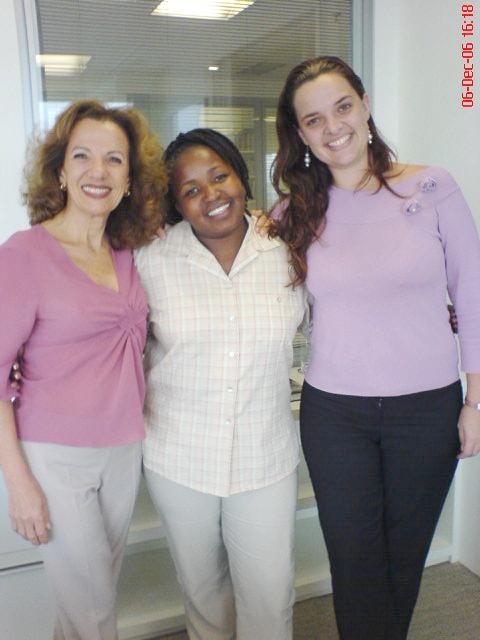
claudia and becky


courtesy of Claudia, i enjoyed nice brazilian dish of pork, bacon and black beans, what in kikuyu we call `wairimu beans` rice and sukuma wiki though they have a local name for the sukuma.
the food was fantastic!!!

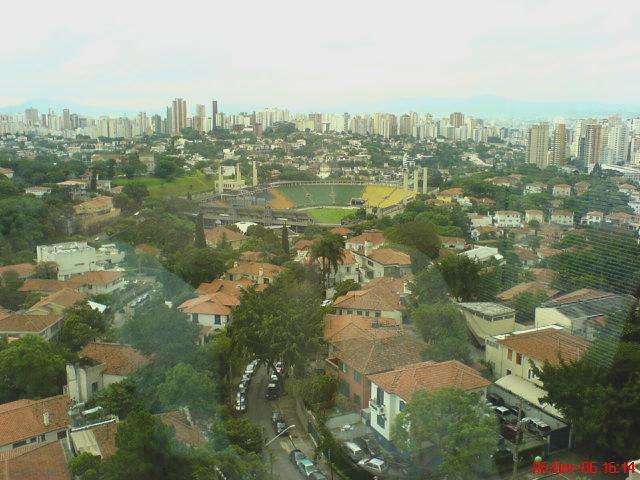
corinthians neighbourhood


SP is a football rich city, with current brazil champions Sao Paulo, Pele´s former club santos and now corinthians. in deed today, Ze Roberto (bayern Munich) was on TV donating stuff at Santos, i did not know the guy is a preacher too......
i remember Roberto Carlos was quoted saying that if he retires from Madrid, he can only play for santos.....

Corinthians FC


am not sure the stadium is well visible but thats where Edu, formerly of Arsenal now with Valencia, was playing. He was `discovered`by wenger in one of his many trips just like he found George Weah, Kolo Toure, Eboue and the like.

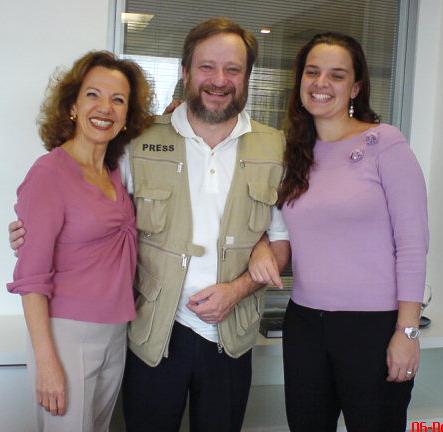
beth, steve and lidia


by the time steve left SP 25 years ago, lidia was a toddler...... now shes married!!!

beth, becky and lidia


i was happy to meet Beth and Lidia, from their office, i had a nice view of the Corinthians football club stadium


Steve was excited to meet the gal, playboy gal. the men on the streets were amused to see me take the pix. am sure they knew we are africans and there is no playboy here. atleast not in kenya.


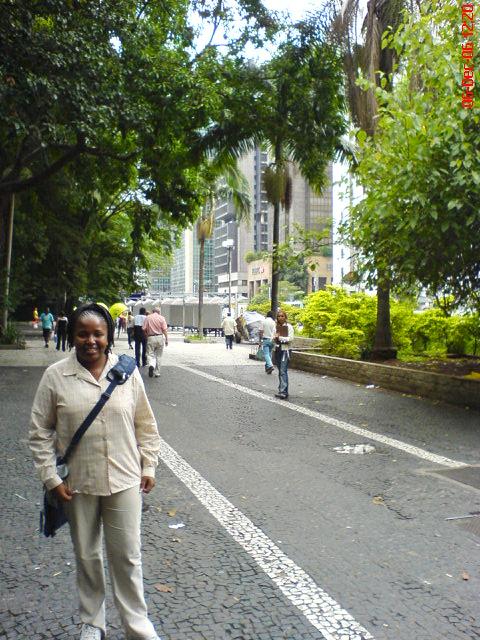
at Avenue Paulista. One of the famous places. Thats where most of that banks are.

TANZANIA ENJOYS FRUITS OF CO-OPERATION

By Rebecca Wanjiku,

When Peter Ulanga was invited to visit Brazil, last year, he knew that something was going to change in the management of dot Tz country code Top Level Domain (ccTLD).

Ulanga, and a colleague, Peter Shilla, benefited from training offered by the Brazilian government on management of domain name registries using open source software.

Within two years of the training, Tanzania Communications Regulatory Authority is ready to launch the dot Tz ccTLD registry. The domain has been administered by the University of Dar es Salaam and individuals.

`The training worked well, we have bought necessary equipment and we are ready to launch Tanzania Network Information Centre, TzNIC,` said Ulanga.

Ulanga says that the training was useful and the tests were successful. He added that it will now be easier to register domains and if there are any problems, then there is a central point to channel complaints.
Tanzania benefitted from the south/south solidarity spearheaded by the South American power house. Kenya was the first to train on how to use the software, Tanzania soon followed suit, while Mozambique and Sudan are lining up for the services.
The gesture by the Brazilian government was calculated to ensure that Africa can access the less costly open source software solutions and transform African registries from manual to automation.
At the on-going Internet Corporation for Assigned Names and Numbers(ICANN) conference, in Sao Paulo, renowned Brazilian Professor Hartmut Glaser could not hide his joy while confirming that he had been invited by the Tanzanian government to witness the fruits of his government´s generosity.
Apart from the training, Brazil offered technical assistance to the recipient countries in case of any problems with the software or even any technical hitches in their operations.
The drive to foster south/south cooperation started in 2002 when Brazil sent engineers to Togo to train local counterparts from more than 20 countries gathered in Lome.
Ends


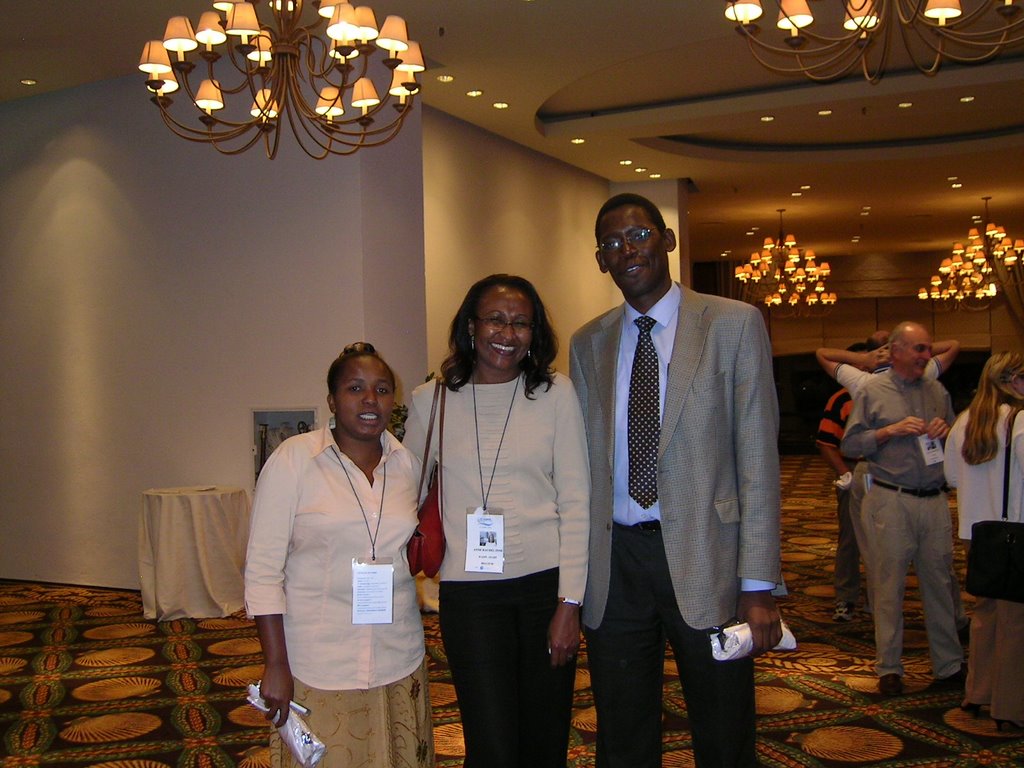
Ann Rachel and Peter Ulanga from Niger and Tanzania respectively. Rachel was instrumental in AFriNIC formation. she is my big sister

Finding Unity in Diversity

By Rebecca Wanjiku
African participants at Internet Corporation for Assigned Names and Numbers(ICANN) meeting in Sao Paulo have formed a unified body that with articulate issues from participants drawn from various sectors.

Africa Regional At Large Organisation (AFRALO) will unite users wishing to articulate their issues to ICANN. AFRALO is expected to link Africa to the global At Large Organisation within ICANN.

Alice Munyua, a member of ICANN´s At Large Organisation says AFRALO will help Africa identify their peculiar issues and call attention to the global body.

¨Through the regional body, African users can identify their challenges and design ways to deal with them. For instance, if the fibre optic cable is laid, then more people can access the internet and then we can deal with other problems other than access,¨said Munyua.

With the growing mobile telephony and cutting edge technology that provides internet via mobile, Munyua says AFRALO will ensure that African voices are heard.

Though not officially launched, preparations of a Memorandum of Understanding are in top gear.

AFRALO is expected to face challenges of language and culture, multiplicity and diversity of digital challenges. Some countries are deemed to have developed ICT infrastructure while others have not.

Munyua expects all countries to meet and point out issues that affect all sectors and the changes they would like to see. The country representatives/ liasons will forward to AFRALO which will then link with the global body.

She recognises that it will be hard to reach consensus because of the diverse interests but she promises AFRALO will work hard to adequately represent african users.
Latin America and the Caribbean have already formed LAC-RALO ( Latin America and the Caribbean Regional At-Large Organisation) which is expected to maximize participation of user groups from the region
Paul Twomey ICANN president, told delegates during the opening ceremony that LAC-RALO will be the third Latin American organisation to help ICANN in its work. The other two are LACTLD (Regional ccTLD managers) and LACNIC (Regional Internet Registry for Latin America ).
Ends

in mar del plata, argentina


celebrating AFriNIC launch at the coastal city. Team Africa was very delighted.

Calling African Scholars

By Rebecca Wanjiku

African scholars interested in developing and preserving indigenous languages have been challenged to take the lead in the Internationalised Domain Name (IDN) debate.


Prof. Maxime Z. Somé, from the University of Ouagadougou in Burkina Faso called on African linguists to actively participate in the IDN project.

`Scientists and scholars should constitute themselves as an exceptional authority in African affairs and move the project forward, said Some.

Some is concerned that Cambodia, Japan, China, Korea and Arabic countries seem to be moving at a faster pace and leaving Africa behind.

In his opinion, linguistic experts as well as scientists in Africa should work together and move the agenda forward. He added that the IDN project requires linguists to agree on the language and terminologies of a particular language and the scientists to work on the technological aspects.

After the agreement of the scripts and language tables, the UNICODE consortium, which consists of computer makers and other bodies, will be expected to integrate the languages into most computers sold to the Africa region.

In this regard, if I have a computer, I can choose the language to use, just like I select to use French or German. In the case of French, the computer inserts the right accents and other letters that may not be available in the English key board.

Asked whether this will lead to development of many key boards, Some says experts can work on some regional languages like Bambara, used in Guinea, Mali, Ivory Coast and Burkina Faso or Fulani, used in Nigeria, Senegal, Mauritania and Mali.

`We know that this project requires a lot of financial commitment and big businesses are not going to invest if not assured of profits. That leaves governments, which have been very non committal, ` he adds.

But he maintains that scholars can jumpstart the process by learning from other countries where experts volunteered their services for the sake of development.

Some spoke at the ongoing Internet Corporation for Assigned Names and
Numbers (ICANN) meeting in Sao Paulo, where the urgency of IDNs has taken
centre stage and its proponents are touting it as a solution to communication problems.

While there are workshops and follow-up meetings to discuss and update on issues relating to IDNs, Africa is stuck with the obsession of listing its numerous cultural and logistical problems as the hindrance to IDN progress.

In 2004, Adama Samassekou, head of the African Academy of Languages was quoted saying there was lethargy within African leadership to use local languages even at Africa Unity meetings Swahili was recommended in 1986
but was used at the AU meeting in July 2004. Swahili is widely spoken in 15
East and Central African countries.
Ends

Wednesday, December 06, 2006


outside Tom Brasil.....

at Tom Brasil theatre in SP


this is where i attended a live show by two Brazilian muscians. apparently there was no much Samba, contrary to popular belif that Brazil equals Samba. theres plenty. i enjoyed.

Loving yourself

spending a night at J´burg international airport is not one of the best thing except if you are booked at the Intercon.

i think the best is the massage palour, it has whats called ``aqua massage``. your body sprayed with water as you lie down.

not naked of course and not like those dingy joints in down town Nairobi where massage can be misataken for other things but pure massage.

its done in full view, though you have to enter into the machine that dispenses water and the whole ceremony begins.

there is also massage on the chair which is also good. so if you are stuck at the airport, make sure you have extra rands.

Tech Challenges

hey guys,
i have been unable to blog coz my blog had been hijacked by some Ghanians, so anything i posted went to their site.
but its ok now....
read on...

almost

hnnnhnhnhnh

Friday, December 01, 2006

The law is truly an ass

today the high court dismissed a case filed by a small girl seeking to strike out sections of the children's Act.

the girl, wanted the court to find that children born out of wedlock had a right to be supported by the father.

what the act does is oppressive to woimen because it places the burden of bringing up a kid born out of wedlock on women.

the court had been urged to make an order that the provisions favors kids in a family set up and discriminates aganist those out of wedlock. in case of divorce, a kid can compel the further to support but in case of illegitimate children......nothing.

high court judges Joseph Nyamu and Mohammed Ibrahim ruled that to strike out the provisions would be retrogressive and unforgivable.....

so you can forgive a father who adsonds his responsibility and heaps it on the mother...... truly an ass.....

Wednesday, November 29, 2006

transvestites in Brazil

am in Sao Paulo next and three of my friends have informed me that there are many transvestites. so, Jemo told me that everyman i see darting me is not necessarily a man, could be a woman dressed as a man and the reverse could be the case.

so, i will have time to write on the young men and my experiences in Brazil. i will make sure i visit night spots as well as the home of Pele, the great footballer!!!

i will be attending the Internet Corporation for Assigned names and Numbers ICANN international meeting.

so i will have more time to spare...... and get you the details....

Tuesday, November 28, 2006

young men who just want rich women

am sure you have all seen adverts in the "soul mate" column where young men just want rich women for sex and money.
well, hang on for my experiences with these yong men!!!
its provoking and funny!!

Monday, September 25, 2006

JOURNALISM TODAY

Today was the first hearing day of the murder case aganist Thomas Cholmondeley, the grandson of colonial settler Lord Delamere.

He is accussed of murdering Robert Njoya, a stonemason who was poaching animals in the expansive farm.

At the court room, one could not help notice the sharp differences between local and international journalists.

When the court adjourned, the local journalists could be ssen in one side, where the director of public prosecutions Keriako Tobiko was, while the international journalists were interested in the defense case.

The stories written reflect the same, the international press reflecting Njoya as a thug who attacked a poor settler. the local press also labours to present the rancher as a heartless and emotionless murderer.

while the local press quotes from another murder of Ole Sisina by the same rancher, the international press goes to great depths to explain the "he was attacked with a panga, like the ones used to kill during civil wars"

So much fo the so called objectivity in journalism.

Friday, September 22, 2006

THE ROCKY ROAD TO THIRD GSM MOBILE PROVIDER

BY REBECCA WANJIKU
Third Global Mobile Service (GSM) is now ready for roll out after Communications Commission of Kenya (CCK) and Econet wireless won the latest legal battle seeking to delay the process until monetary issues are sorted out.
High court judge Mary Kasango struck out a suit filed by Kenya National Federation of Cooperatives Limited on a technicality. KNFC was seeking the court’s indulgence in its effort to avoid the month’s notice required before the suit can be filed. The procedure is prescribed under the Communications Act (1998).
Justice Kasango ruled that the law does not allow her to waive notice adding that the constitution allows her to be guided by written laws. She also declined to exrcise the inherent jurisdiction because such powers only exist where the law is not written or is unclear.
“KNFC finds itself without a leg to stand on. It can not obtain a waiver since the Act does not provide for such waiver. The court’s inherent powers can not salvage the situation,” justice Kasango found.
The Federation moved to court under a certificate of urgency seeking to block CCK from issuing frequencies and other technical fulfilments that were agreed under the licence.
The licence was awarded to KNFC together with its partners, Econet Wireless Kenya, Econet Wireless International Limited and Corporate Africa Limited in 2003 but the consortium has faced a rocky union because KNFC could not raise its required financial quota.
Justice Kasango was ruling on a preliminary objection raised by CCK contending that the court had no powers to issue any orders based on the papers filed by the Federation.
Lawyer Walter Amoko representing CCK told justice Kasango that the Communications Act provides for a period of six months within which an aggrieved party is expected to lodge the dispute. He argued that the Federation had slept on its rights for two years before filing the suit.
Lawyer Njoroge Regeru representing Econet told justice Kasango that the Federation had failed to disclose that there were other proceedings that had been argued before high court judge Mohammed Ibrahim. The consortium was invoved in a protracted legal tussle over shareholding but the case was decided against KNFC. The Federation has filed its appeal.
When the Federation was supposed to present its case on why the suit should be sustained, the lawyer, C.N Kihara did not appear at the appointed time. He only turned up after the judge had waited for half an hour and closed the proceedings of that day. The case was therefore based on the arguments presented by CCK and Econet.
Ends

OF YOUNG AFRICAN GIRLS AND OLD WHITE MEN

It all started at a salon in Dar Es Salaam TZ, a Kenyan gal entered together with her “lover” who wanted her to have her hair done. The gal spoke with a strong Kenyan accent and the gals directed her to her “sister”. I had a chat with her and wanted to know where in Kenya she comes from, and she said; “coast”. Of course I could tell her kikuyu accent.

Being a kikuyu and with lots of prejudice as you can read, I enquired how I can hook up with an old white man who can take me places and pamper me as she had. She had gone on and on about the places she had been on holiday, courtesy of the white guy. We were all in laughter as we sought to know how they hooked up; it was all brewed over the internet!

The Internet!! We all said in unison maybe marvelling at the exploits of technology. We also bitched about how Kenyan girls are good at taking advantage of opportunities coming their way. I must say that is true. But the Internet has only provided us with a new realm.

So much for the Dar incident but my day of reckoning was to come.

At a shopping mall in Luxembourg, I had accompanied HANA editor Steve Lang for the ICANN meeting. We wanted to have lunch but we could not agree. He wanted Japanese salad and I wanted a taste of Thai.

You see, am used to Nairobi shopping malls where you buy food anywhere and sit anywhere in the food court. Not in Luxembourg! If you buy Japanese, sit at their space and Thai has its space. But we wanted to sit together.

So when I went to buy my food, the gal at the sushi bar told Steve, “tell your wife she can sit with you”. So Steve called me and we sat. When leaving, he told me what the gal had said.

And I wondered, how could she think of that, but then I thought that is what we are known for. But I have no intention of hooking up with a pensioner.

So much for the trophy wives.

Thursday, September 14, 2006

Wednesday, September 13, 2006

REBECCA WANJIKU'S BLOG

DEFYING MYTHS
BY REBECCA WANJIKU

African journalism is contributing to development and the situation will improve if journalists overcome myths and obstacles, said Highway Africa Director, Chris Kabwato.

In his welcome address, Kabwato drew an analogy with the Greek mythological figure Icarus who is famous for flying closer to the sun and his artificial wings melted.

Welcoming more than 500 journalists from 42 countries Kabwato said it was possible for African journalists to break the myths that dictate how issues should be covered and represented through media.

“Let us all defy the Greek mythology and fly closer to the sun than Icarus. Let us dare to challenge the economic policies and issues of democracy in our countries. Let us shake the fundamental myths and transform the way we do journalism,” said Highway Africa Director, Chris Kabwato.

Kabwato underscored Highway Africa’s commitment to training of African journalists on ICTs, research, information provision and the conference which offers networking opportunities for media practitioners.

Prof. Guy Berger, Head of the school of journalism and Media studies at Rhodes University said that in the last ten years, African journalism has overcome a lot and the progress is encouraging.

“Ten years ago the internet was barely known. Right now we can talk of the digital divide and the differences in access between rural and urban areas. We are a movement, a community, and an incubator for ideas waiting development,” said Berger.

While emphasizing the need to learn and embrace new technology, Berger said that Highway Africa is not an engineering school but seeks to empower journalists to communicate using ICTs.

The ICT tools, Berger added, should be used in the context of other pressing issues such as economic policies, culture and peculiar circumstances that a country maybe facing.

“There is passion in what we are trying to do. HA is ten years old and in the upcoming teenage years, there will be excitement and lots of experiments,” Berger concluded.
Ends

REBECCA WANJIKU'S BLOG

AFRICAN GOVERNMENTS PUT ON NOTICE

By Kezio-Musoke David and Rebecca Wanjiku

African governments who gag investigative journalists have been put on notice, courtesy of modern computer applications available on the World Wide Web, said Tom Johnson managing director, Institute for Analytic Journalism.

Johnson said technology will make it hard for governments or other agents affected by investigative work to destroy journalistic work.

While training journalists on the available Web operations that can guarantee security, sharing and storage of their work, Johnson said that the Internet is promoting freedom of _expression and making it harder to destroy vital information.

“Web 2.0 applications can be used as weapons to fight corruption. Web 2.0 Applications will not directly fright corruption but will equip journalist with resources to do better investigations, research and analysis,” Johnson said.

In countries known for investigative journalism, media houses have been burnt and computers stolen by agents opposed to publication. For instance, in Kenya the government stormed The Standard Group, carried computers and burnt newspapers. The move was calculated to force the Standard Group to abandon serialisation of corrupt deals by the government.

“It is now easy to scan documents and store them digitally; they will be available everywhere in a computer. Digital storage acts as backup incase the hard disk is stolen or destroyed,” Johnson said.

Johnson acknowledged that the technology may not be fully available to all journalists in Africa but noted that the continent is growing at a fast rate and introduction of the internet tools will improve investigative journalism.

“I am surprised that in Africa the use of SMS applications is massive as compared to North and South America . This is exactly what I am talking about. The integration of digital technology with the use of Web 2.0 can be very useful in and environment where the infrastructure is limited,” he added.

Web 2.0 is an open source software available free or low-cost. According to the journalism trainer, these applications are continually collaboratively updated making it easier for users to suit it to their needs.

In this respect, Johnson said the applications can allow journalists to research, write, analyse and store information on the internet. The applications make it easier for journalists to share the information and continually update, erasing the need for physical presence. For instance, journalists in Cape Town and Durban can follow similar stories and update via the web without meeting.

Regarding on-line storage, Johnson singled out Google’s Gmail which offers users 2.7 GB, Yahoo, 1 GB and all files can be shared. Others are, Freedrive
http://www.freedrive.com, and Fortune City.

On sharing information and editing, he suggested several websites that allow various options for book marking and follow-up of web links. Examples: www.google.com, www.writely.com, www.socialtext.net, www.zoho.com and mediawiki.org/wiki/MediaWiki

Ends

REBECCA WANJIKU'S BLOG

GOING DIGITAL: RADIO IN THE FUTURE
By Rebecca Wanjiku
When Maphule Mbhalati was growing up, radio was a classified tool signifying status and wealth. Her grandmother was a proud radio owner and everyone marvelled at the sound waves and wondered how news was produced.

Today, the head of radio news and current affairs at SABC has a message for remote and poor communities that have no access to radio: we are coming to you!

Speaking at the plenary session, Mbhalati told journalists from 42 countries that digital and Satellite radio is poised to revolutionalise how news is disseminated in remote and poor communities in Africa .

“At SABC, we have several radio stations and each of them has an outside broadcast vehicle to visit remote areas. In the absence of a vehicle we have satellite radio that can be received beyond boundaries,” Mbhalati said.

Through digital and satellite radio, Mbhalati said communities can tell their stories and can interact with radio presenters or comment on issues covered by the station. Mbhalati was chairing a session titled Radio in Africa : yesterday today and tomorrow.

“In the past, radio was communal, today it is a fusion between communal and individual tastes, in the future, people are going to decide when the can listen and what they listen to. They will make their voices heard through satellite, digital and internet radio,” Mbhalati added.

Rayborn Bulley, a journalist from Ghana detailed how military dictators took advantage of the single national radio stations to announce the coup and suppress any uprising.

According to his experience, the 139 radio stations in Ghana had promoted freedom of _expression and political accountability but had raised questions regarding journalism ethics and professionalism.

“The FM stations are not employing professionals; many of the presenters are disk jockeys or celebrities. Radio is forcing us to rethink about who is a journalist and who is not,” said Bulley.

Responding to the concerns of non professionalism, Macharia Gaitho, a senior editor with the Nation Newspaper in Kenya said that with the liberalisation of the airwaves has come with its own anarchy.

“I would rather have the anarchy that is there than situations where military dictators take over a radio station and announce their power take over,” Gaitho said.

Regarding professionalism, Bulley acknowledged that the politicians complain anytime listeners call the stations and air negative comments.

Acknowledging opportunities that presents, Portia Kobue from Kaya FM in Johannesburg associated herself with sentiments expressed by Nobel Laureate Wole Soyinka who says radio has grown from a propaganda tool to an empowering tool.

“Days are gone when radio news would be characterised by two simple sentences. We need journalists who can tell stories, impact lives,” said Kobue.

Ends

Thursday, August 10, 2006

REBECCA WANJIKU'S BLOG

Look out for news from Highway Africa, September 10-15, 2006

Wednesday, June 28, 2006

ICANN TO IMPROVE AFRICA PARTICIPATION

By Rebecca Wanjiku

Africa’s participation in Internet Corporation for Assigned Names and Numbers (ICANN) meetings is set to improve following a decision by the organizers to provide scholarships.

“In the 2006/2007 budget, ICANN has factored in provision for scholarships for Africa’s participation,” said Paul Twomey, ICANN president.

Twomey says there has been an increase in Africa’s participation but is quick to note there is need for an increase in numbers of participants.

There has been intense lobbying by Africans participating in the meeting for improvement of the number of participants from Africa. It has been argued that most Africans lack the financial capacity to travel to these meetings.

“It is true that some of our governments have no capacity to finance their officers to these meetings,” said Mouhamet Diop, a former ICANN board member.

Whilst finance may be the case, the continent suffers from its obsession with bureaucracy and red tape. Most governments release their officials if the meeting is by another government and on an official letterhead.

Maimouna Diagne from Senegal adds that some governments wonder what participation in the meetings is likely to yield for the governments.

“A government official is expected to demonstrate the importance of these meetings and at times it’s not easy. The invite is through email and it may not be as official as some governments want,” adds Maimouna.

Apart from the financial support, she says there is need for workshops and trainings to raise awareness about ICANN and its operations in Africa. She feels there is need for Africa to understand the role of the Government Advisory Committee (GAC) in ICANN and how they can participate.

In GAC, governments have a chance to discuss issues affecting them and how they can work together with the private sector. According to Mohamed Tarmizi, GAC chairman, it started being active in 1999 and was seen as a process of moving ICANN to another level.

Tarmizi says that in the meetings, members are encouraged to address pressing issues relating to internet and internet governance within the 110 member countries.

“How do we start discuss who does or does not govern the internet while a country has no broadband connection, has no undersea cable and satellite uplink is not working well. Within our informal networks, we try to encourage governments to work on their priorities,” Tarmizi adds.
Ends

Tuesday, June 27, 2006

AfriNIC STILL GOING STRONG

AfriNIC STILL GOING STRONG
By Rebecca
When the idea of establishing a Regional Internet Registry (RIR), was floated in 1998, pessimists dismissed the idea arguing that Africa is incapable of sustaining the registry while others said that we need to take part in the digital race.

A year after AfriNIC was given full recognition and backing by the Internet Corporation for Assigned Names and Numbers (ICANN), the organization has made major strides towards allocating Internet Protocol (IP) addresses and training.

“We have conducted training in Egypt, Sudan, Nigeria and Kenya. We are hoping to harness the human recourse so that we can have people to offer these services as new technology emerges,” said Adiel Akplogan, AfriNIC chief executive.

AfriNIC was recognized last April at a meeting held in Argentina. Previously, African Internet Service Providers (ISPs) had to work with other RIR in Europe and North America.

But Akplogan admits that technology consumption still poses a major challenge and is not as rosy as it may suggest. For instance out of 15 million IP address, Africa has only used up 6 per cent.

“I believe there is still lack of aware on the availability of such services. Some network operators in the region do not know they can come to AfriNIC and get the allocations,” said Akplogan.

While the slow uptake of uptake of IP address has been blamed on the lack of awareness, it is also argued that the prices charged are still high for a market that is still struggling with issues of accessibility.

Pierre Ouedraogo, from Burkina Faso says that the prices have been reduced to fit the African market given that before AfriNIC prices were dictated by other regions depending on the area of allocation.

“In 1997, I got the first IP address block from Europe; Burkina Faso has not exhausted these numbers. All Africans should believe in our movement, telecommunication agencies, governments and technology experts should engage in outreach activities to ensure as many people as possible are aware of the services,” Ouedraogo said.

There is debate whether Africa should proceed with allocation of IP version 6 or first exhaust the available version 4.

However, Akplogan and Ouedraogo feel that if a country has the ability to roll out IPv6, then it should not be restricted. They contend that it is easier to adapt to the new strategy since some had not even taken up the IPv4.

IPv4 has been in use since internet was discovered and there has been a push for a newer version that would adopt more features. IPv6 has improved functions, compared to version 4.

“It’s the future of the networks, have to follow technology evolution, what people are doing now, there is no need to wait” said Akplogan.

Akplogan admits that after the World Summit on Information Society (WSIS) and the ensuing debate on Internet Governance AfriNIC has been forced to be focal point on such issues in the region.

“We need more resources to deal with different issues without neglecting our core business which is allocation of IP addresses,” Akplogan added.

Ends

Monday, June 26, 2006

ICANN IN MARAKESH

At the tourist city of Marrakech, Internet stakeholders are gathered for the Internet Corporation for Assigned Names and Numbers ICANN meeting.

Moroccan Prime Minister Driss Jettou graced the ceremony and gave his government’s testimony of how Information Communication Technology ICT can leverage modernization and territorial administration.

“Through internet development, Morocco is well anchored to provide essential services locally and abroad,” Jettou said.

To demonstrate the development, Jettou noted that the country has provided four million employment opportunities compared to a million jobs created online in 2004.

This, he added, has been through concerted efforts between the government and other players of improving access, content and training.

In access and training, the prime minister says the government put aside USD 100 million to equip secondary school students with necessary skills. The project is expected to be rolled out fully by 2008.

“The government is using internet to provide essential services such as information on revenue collection, justice department and overall administration,” added Jettou.

ICANN board chairman Vint Cerf lauded the Moroccan government’s effort saying that the country was at a vantage point to provide services in French and Arabic.

“This meeting is going to discuss how non English languages can be effectively used in the internet. How morocco can effectively provide services beyond its borders using French, Arabic or other languages,” said Cerf

The use of non English language and not Latin alphabets is commonly known as Internationalized Domain Names IDN. The meeting is expected to report on progress in rolling out the project.

The project has been well embraced and championed by the Chinese, Koreans, Japanese, French, and Arabs. The rest of indigenous African languages are still in conception stage and there is no clear way forward over financing or the term of the conception.

According to Paul Twomey, ICANN president, the meeting is geared towards open discussions on various issues affecting the industry.

“There will be discussions relating to the ICANN memorandum of understanding with the American department of commerce, which expires in September,” said Twomey.

The meeting is expected to be the theatre of protracted debate between governments and industry specialists on what amount of user information should be available for scrutiny and whether the disclosure may amount to violation of individual rights.

ICANN will hold discussions between government representatives and stakeholders and establish the way forward. Governments argue that the information would help in cases of fraud and other illegal activities while the industry wants freedom for users.

“There will be representatives from Holland, Japan and USA to add flavor to the discussion on the debate,” Cerf concluded.

Ends

Monday, April 24, 2006

Thursday, March 30, 2006

Midwives for new ICANN

ICANN PREPARES FOR DISENGAGEMENT
By Rebecca Wanjiku


The Internet Corporation for assigned Names and Numbers (ICANN) has appointed a 10-man committee to discuss and give recommendations on its new role after the memorandum with the US government expires this year.

The committee is composed of big names in the Information Society and is expected to help identify characteristics of a model that will satisfy the internet community as well as governments.

“The committee will be mandated to study the environment surrounding conclusion of the MoU and advise on how issues of government and non-governmental entities can be addressed,” said Paul Twomey, ICANN president.

The strategic committee appointed under the president, has three co-chairs- ICANN board member Peter Dengate Thrush, former Swedish Prime Minister, Carl Bildt, and Twomey. ICANN board chairman Vint Cerf is an ex officio member.

Other members include; former chair of the first preparatory committee for the World Summit on Information Society (WSIS) Adama Samassekou, Janis Karklins, who was the chair of the second preparatory committee, Thomas Niles, and Marilyn Cade.
Twomey informer the public gathering in Wellington that two senior business figures in the United States have verbally agreed to be a members but he did not have written confirmation from their offices and he could not give their names.

But participants raised questions regarding composition of the group and what its main objective was. There were questions whether it was supposed to merely represent regions or was a diplomatic exercise actuated by the need to present ICANN as an international body.

ICANN board member Raimundo Beca questioned the composition noting that South America was not represented in the arrangement.

Cerf said the members were selected to reflect the international nature of the committee and to solicit opinions from outsiders regarding how the internet oversight body should be ran.

“The committee is expected to form additional source of information from people who don’t come to ICANN meetings. It is a multi-stakeholder structure and we tried to be as inclusive as possible,” said Twomey.

Before ICANN disengages from the US department of commerce, it is expected to fulfill requirements by ensuring that it has implemented a consensus policy regarding new generic Top Level Domains (gTLDs) and establish accountability frameworks with country code Top Level Domains (ccTLDs) e.g. .co.ke, .co.ug, co.za and many others.
ICANN is also expected to execute addition MoUs with Regional Internet Registries (RIRs) describing duties of all parties. RIRs include; AFriNIC for Africa, RIPE NCC for Europe and the Middle East, ARIN for North America, LACNIC for Latin America including the Caribbean and APNIC for Asia-Pacific region.
Ends

What is ICANN?

HOW ICANN OPERATES
By Rebecca Wanjiku
What is the Internet Corporation for Assigned Names and Number (ICANN)?
To some, it is the Internet oversight body, to others; it is an organisation that champions ideals of the US government others know that it deals with technical stuff while others have no idea what all this hullabaloo about ICANN is all about.

Well, in whatever way you define it, ICANN affects our lives today and will continue doing so as long as we are in this information super highway.

Its major responsibility falls under the Internet Assigned Numbers Authority (IANA). This service ensures that business runs smoothly on the internet and is well prepared in case of any physical or business disruption. It is in IANA that ICANN regulates the internet registries, registrars. There are other organs of ICANN such as Government Advisory Committee (GAC), but dealing with IANA functions makes it easier to understand.

Through IANA, ICANN determines who runs the dot net domain, dot org or dot com. Dot com and dot net domains are ran by an American firm- VeriSign- which has been subject of discussion in many internet related forums.

The main subject in the forums has been the recent settlement was a culmination of a protracted legal tussle between ICANN and the company. The settlement allows VeriSign to increase the cost of domain names and it is presumed that the contract to run the domain names will be automatically renewed when it expires.

The decision to settle did not augur well with stakeholders who saw it as a way to extend the monopoly enjoyed by US organisation. The feeling was well demonstrated during the bid to run dot net domain name, which was won by VeriSign.

“All stakeholders who responded in the public forum were against this settlement. The bottom-up approach assumed by ICANN could not have reached this decision. The reasons given by the board for the decision are not sufficient,” summed Collin Jackson, from New Zealand. He was addressing the board during the public forum.

Elliot Noss from Canada had a complaint against ICANN staff for failing to supply him with documents supplied by VeriSign in support of their proposal and the documents supplied by board members before they decided to settle.

“The staff has a duty to be transparent, we had no idea of what was going on,” added Noss.

In short, those who attend ICANN meetings come to represent their interests. Nobody cares whether Africa is represented or not. If any help or any consideration is needed, governments, regions and entities such as businesses form a caucus and champion their rights.

Africa has minimal representation and though it has two members on the board-Mouhamet Diop from Senegal and Njeri Rionge from Kenya- there is no critical mass to identify what interventions are needed.

For instance, to ensure that pornographic sites are not given the freedom to operate under dot XXX domain name, some opposing governments made sure their voices are well articulated under GAC.

Simply, that is how business is conducted at ICANN meetings, you got an issue, and you have to make it heard! This is not World Bank or International Monetary Fund so for any change, human and material resources have to be pulled together and there has to be tangible results.
Ends

Tuesday, March 28, 2006

ICANN and language

ICANN TO USE MORE LANGUAGES
By Rebecca Wanjiku

The Internet oversight body is embarking on an ambitious project aimed at ensuring its materials and resources can be accessed in local languages all over the world.

Internet Corporation for Assigned Names and Numbers (ICANN) has promised to increase availability of their newsletter and website in various languages. Currently, some materials have been translated to Kiswahili.

Though ICANN has not specified the languages it is planning to embark on, it has invited participants to scrutinise its strategic plan and raise their concerns.

The move to increase the number of languages is calculated to facilitate effective and multilingual communication and allow participating communities to interact.

“Translation will improve ability of stakeholders to participate in ICANN processes including in languages other than English,” said Kurt Pritz ICANN vice president in charge of business operations.

Kurt told participants of the meeting in Wellington that the project will create an operational policy and guidelines to steer future translation efforts.

“Translation is not an end rather a means to an end,” added Kurt.

Ends

Morocco

ICANN IN MOROCCO
By Rebecca Wanjiku

The last time ICANN held its meeting in Africa, there was a unanimous call for the internet oversight body to increase its outreach programs and presence in Africa.

Two years after Cape Town 2004, ICANN appointed an Egyptian, Baher Esmat as the Global partnership Liaison for Middle East, Ann-Rachel Inne from Niger as the Liaison for Africa, and will hold the next meeting in Marrakesh, Morocco.

For the North African country hosting the ICANN meeting will be a challenge as well as an opportunity to showcase their ICT prowess.

“We met the criteria set by ICANN to host meetings. We have good internet connection as well as tourist facilities,” said Hamida Benlemlih, project manager at the Moroccan telecommunication ministry.

According to Hamida, the meeting will give visitors a chance to see Morocco and witness the progress made in bridging the digital divide.

She admits that Morocco experiences a gap between the urban and rural areas in terms of ICT accessibility but notes that the government has made considerable progress. In Morocco, 4.5 million can access ICT out of a population of 32 million.

Ends

Knowing New Zealand

KNOWING NEW ZEALAND
By Rebecca Wanjiku

What comes to your mind when you think of New Zealand? Kiwis? Rugby? Cricket? Maori? Or does it strike you like this well developed nation which is strict on importation that you cant even bring in a half chewed fruit?

Whatever you have in mind, it may be true. They are known as the kiwis, play cricket, they whip their opponents in most rugby matches and they perform the infamous haka dance after every win.

The importation laws are so strict that a Kenyan friend warned me to alert the customs officials about some candy I bought somewhere in transit. They got strict penalties for non compliance.

That may be one side of New Zealand but when it comes to Information Communication Technology, they have a different story.

They have three telecom providers but even in the conference hall, the internet connection is erratic, probably reminding one of connection in some of our countries.

The erratic connection may lead one to the question, “I thought New Zealand was way ahead in ICT development?”

No! New Zealand has some rural population that has no access to mobile phones let alone internet connection. Though the rural population is mainly the indigenous Maori, there are some white settlers too.

According to Karen Burns, a senior analyst with the government’s interoperable programme, they are working hard to ensure that the rural areas in the south and north islands is well connected with ICT.

“The government is trying to make it as easy as possible to access ICT. The government has an interconnected website where residents can access government services in one site,” said Burns.

The government has also set up special training programmes for Maori and other Pacific island residents to ensure they are well versed with technology.

According to Burns, the website is accessible in English and Maori languages and the people tasked with the online services can speak a host of other languages to make it easier for everyone.

New Zealand was originally occupied by the Maori before the British settled. A treaty was signed between the Maori and British that the locals would own land that was originally theirs, if they can prove the ancestral lineage.

This contract, Burns says, is still honoured to date though it was signed in 1840. She adds that if a person can prove that the land was unfairly taken and prove the lineage and ownership, the courts have a right to enforce it.


Ends

Monday, March 27, 2006

INTERNET AS A TOOL FOR CULTURAL INTEGRATION

INTERNET AS A TOOL FOR CULTURAL INTEGRATION
By Rebecca Wanjiku
Internet Corporation for assigned Names and Numbers (ICANN) opened its doors to the public in Wellington with particular emphasis on using internet for cultural integration.

In his opening address, Vinton Cerf, ICANN board Chairman, invited participants to develop innovative applications to ensure internet is important to cultures as well as economic growth.

“We need new idea and new applications to create substantial growth and development,” said Cerf.

In the past, Internet has been marketed more as a tool for economic progression and less as a vehicle to preserving culture and social development.

The meeting was officially opened by Hon. David Cunliffe, the minister in charge of communication and Information Technology in New Zealand.

“The principle focus of this meeting will be how improved access to ICTs can assist in regional economic and social development,” said Cunliffe.

The meeting precedes another gathering of communication ministers from the Pacific Island Forum scheduled for March 30th 2006. Cunliffe identified the ICANN meeting as an important forum to small isolated island populations who wish to save their cultural heritage in an increasingly globalised and networked world.

The minister called all governments to participate to participate in internet issues mainly the central coordinating functions that ICANN deals with.

In his speech, he drew parallels with the World Summit on Information Society (WSIS) which focused much attention on the need for better access to internet resources by developing countries.

“The New Zealand government welcomes the Tunis Agenda and especially its call for greator online participation from least developed nations,” said Cunliffe.

The thorny question of Internet governance or ownership was also addressed at the opening with Cerf insisting that ICANN does not control internet assets in any way. He maintained that there are new discoveries every day and 99 per cent of internet applications are yet to be developed.

Paul Twomey, ICANN president and Chief Executive Officer also emphasized that the organization merely coordinates various internet functions.

This meeting is expected to further discussions on development of Internationalized Domain Names (IDN), which will allow use of African languages with proper accents on the net.

The issue of Internet Protocol version 6 (IPv6) will be discussed and is expected to shed more light on global policy and allocation.

ENDS

Friday, November 18, 2005

ITS UNITY OR NEVER FOR AFRICA

BY REBECCA
African governments, private sector and civil society organizations have pledged to form an unprecedented alliance to ensure that the continent establishes a full fledged internet industry.

Delegates attending the World Summit on Information Society (WSIS) have promised to co-operate and oil the engine of development in Africa and implement the Tunis commitment and Plan of Action.

Theophilius Mlaki head of Information and Documentation at Tanzania Commission for Science and Technology said there was need for the government to enter into strategic partnerships in order to fully and quickly implement the Plan of Action.

“We know the challenges, strengths and fruits of working together. It is the only way to develop Africa,” said Mlaki.

After Tunis, Mlaki says the government will implement the research it has already conducted and liaise with the private sector and civil society organisations to implement research findings and educate the public on ICTs.

One of the findings is that ICT development can be incorporated with other spheres of development such as water provision, agriculture, and health and road construction.

To illustrate his point, he said the government has collaborated with the Chinese in a water project where the pipes are dug, fitted and a fibre optic cable laid at the same time. The 100-kilometre water pipe system between Wami and Challenge in Coast region is the highlight of what alliances can achieve.

Pierre Dandjinou, Chairman of AfriNIC board, admits there is need for concerted efforts adding that every sector must play its role. AfriNIC is the Regional Internet Registry (RIR) tasked with providing Internet Protocol (IP) addresses.

He said African governments must play regulatory role and provide enabling environment for businesses to thrive and private sector as well as civil society must collaborate in research and innovation.

“Today, Africa is merely a consumer of internet business. We need to start an industry and all players must be involved,” said Dandjinou.

If internet business thrives in Africa, then AfriNIC will offer requisite addresses and support, communities will be connected and jobs will be available for many people who may be currently unemployed.

In this respect, Dandjinou says different regions can network and exchange ideas and governments can make relevant policies and make budgetary allocations for telecommunication development.

On the same breath, the Sudanese government used the summit as a forum to attract multinational companies and government agencies interested in investing in the south of the country that has experienced civil war for 20 years.

Khateeb Dafi, Secretary General in the ministry of Information and Communication said the government has a subcommittee that is going to meet and assign responsibilities according to the Plan of Action.

According to Dafi, the largest country in Africa has laid a 100-kilometre fibre optic cable in conjunction with Sentech of South Africa and has four telephone providers, two for mobile and two for fixed line.

“The summit has been a success for us, we made contact with companies from Italy, Spain and Malaysia and we are hoping to finalise a deal to establish radio stations across Sudan,” said Dafi.

In Benin, all participants from private and public sector are planning to meet and chart the way forward in implementing the Plan of Action. Kouferidji Ramanou, Director General of Groupe Africoncept Broadcast Telecom S.A said the Action Plan had a lot of challenges and success stories that can be replicated in the West African nation.

Dorothy Okello, Executive Director of Women of Uganda Network (WOUGNET) emphasized the need for public and public sectors to work together and for more money to be channeled to implementation of the plan.

“We have all been working on our projects in respective countries. We can no longer work in isolation. We have to unite, share lessons and way forward in implementing commitments made in Tunis,” she said.
Ends

Thursday, November 17, 2005

WSIS RISKS LOSING MOMENTUM

BY REBECCA

The World Summit on Information Society (WSIS) risks losing its momentum unless proper implementation and commitment is assigned to various actors, Africa Civil Society Organisations claim.

The group of Non Governmental Organisations from all over Africa has labelled the Tunis phase of the summit as a flop and a recipe for in action if participating governments do not inject a fresh dose of commitment to ensure commitments made in Geneva two years ago are implemented.

Nnenna Nwakanma, a member of the African civil society caucus says she believed the summit was going to be a solution to commitments made and promises made in Geneva. She also thought the summit was going to determine the responsibilities of various players since problems were diagnosed in Geneva.

“The content is a failure and big disappointment for Africa’s desire at WSIS. It was not an engagement forum, we have participated in a political process and not a process committed to building access to ICTs,” said Nnenna.

In the absence of such commitment, Nnenna argues it would be hard to bridge the digital divide and ensure access.

“This second phase has no renewed commitment and the follow-up is less than clear. Someone has to take the initiative to save it from losing momentum,” says the ICT consultant.

At the same time, Nnenna says the meeting lacks a clear way forward and participants may have to attend another meeting to define mandate and assign responsibilities to various participating entities.

Besides, Nnenna feels that too much money has been spent in organising the summit yet it discussed mainly issues to do with Internet governance and financing.

In this respect, Khaled Fattal the chairman of the Multilingual Internet names Consortium argues that the biggest losers are the communities whose languages are not even used on the internet.

“We wanted action not compromise. People are expecting action not talk. If people are hungry, give them food not consultation, if they have no access, connect them, do not call for dialogue,” says Fattal.
Ends

Wednesday, November 16, 2005

TRANSLATING COMMITMENTS TO ACTION-WSIS

By Rebecca Wanjiku

It was a breath taking moment as more than 100 Cameras rolled at the same time and a crowd of about a thousand delegates rose in unison and applauded.

It was the official opening ceremony of the World Summit on Information Society (WSIS) and the host - Tunisian president Ben Ali walked into the plenary hall accompanied by United Nations Secretary General Koffi Annan, ITU secretary General Yoshio Utsumi, president of the preparatory committee Janis Karklin, Swiss president Samuel Schmid, Nobel Laureate Shirin Ebadi and Craig Barrett from Intel Corporation:

As they took their seats, the giant television screens and state of the art cameras captured every moment and the security detail, which is trademark in such meetings ensured that everyone took their place.

There were no traditional dancers, no camel dancing or children singing their tunes, here there were men and women, dressed in suits, traditional wear and holding on to their laptops, camera phones and other communication gadgets.

The civilian-dressed security officers formed a single file signifying the difference in seating arrangements. The observers were not allowed to sit with the government delegates and another file equally kept off the photojournalists.

Most participants were locked out of the plenary hall as the organizers directed that only four members per delegation were allowed in and observer badges were given to organizations. There are 150 countries represented at the meeting.

It was time for the host president to welcome the delegates.

A confident looking Ali heaped praise to the host country and to ITU for accepting the proposal to hold WSIS “in this beautiful and ancient land of dialogue and tolerance”. The participants listened keenly.


After underlining the historical significance of holding the summit in Tunisia, he invited the UN Secretary General to address the gathering.

When he rose to the podium, he was as calm as always, did not read any speech but spoke from his heart. His emphasis on moving from dialogue to deeds and the movement of his hands demonstrated the confidence he had that both the government and private sector were capable of bridging the digital divide.

The ability to bridge the digital divide was also stressed by the Swiss president who got special attention from the floor when he said it “is unacceptable that some UN members still imprison those who criticize their governments.” The clapping grew louder when he insisted that freedom of expression and information should be the central themes of WSIS.

His speech was a milder version of what Shirin Ebadi had to say.

The Iranian lawyer made a stinging attack on government that set aside huge military budgets yet complain about digital divide and the heads of government that start the own NGOs then send them as representatives to such meetings.

But the ovation greeted her when she demanded liberation of prisoners of conscience and for an end to filtering of certain internet sites that some governments forbid their subjects from visiting. She was speaking on behalf of Civil Society.

After an hour of marathon speech, six African heads of government were given a chance to address the meeting. It was a time for them to recite their gains as well as challenges in bridging the digital divide.
Ends

Tuesday, November 15, 2005

COVERING WSIS: MY EXPERIENCE

COVERING WSIS: MY EXPERIENCE
The birth….

I was overjoyed when I got a chance to attend the WSIS preparatory committee meeting in Geneva, (September 2003). To me, being on the Highway Africa team was a break that I was waiting for and I am not disappointed.

It was my first time to a PrepCom, first time I was out as a team of pan African journalists and was the first time I was in Geneva, the fabled city that everyone dreams to visit, if you have enough money.

My mother tells me that I have always been assertive and that I do not easily yield to challenges. I must admit she was right, as she always is.

My excitement was still there but I struggled to get a story. I could not understand the issues well. Though there was a mountain of documentation, it was not easily digestible and was making news per se.

But I was in good hands, Steve Lang, a veteran journalist had accompanied Emrakeb Assefa and I. Granted the conferences he has covered and his wealth of experience, we were able to pick his brains.

Soon I learnt that the best way to get a story is mill around the Civil Society, and government delegations, who are the main participants. Usually the role of CS is to propose changes and the governments to oppose alter or ignore the CS contributions.

The easiest way to get to governments is through your country delegations and in the Kenyan team, I had Wangusi and Mercy. I had people who I could converse in Swahili and my mother tongue- Kikuyu.

Thanks to Wangusi who chaired the internet governance group, I found my bearing and began to understand the dynamics. He explained to me the whole politics of the internet and the selfish interests that underlie the intergovernmental negotiations. At this time, issues of internet governance and financing were shaping up, and I am glad HANA was there to chronicle these important moment.

I could tell that Mercy and Wangusi were happy to take me through the rigors of PrepCom. Though I was asking obvious questions, they happily answered, and for that, I am grateful. Of course they recited the usual poem about the myopia that Kenyan journalism is and decried the lack of sufficient analytical rigor on issues of ICT policy and implementation.

At that time, I was the emblem of ignorance among journalists and was given a chance to prove whether their poem had some basis. At the time, I was guilty of the charges of ignorance and myopia as far as ICT is concerned, but not anymore.
So, the birth of my ICT understanding and writing had several mid wives…..

Watch out for the next piece
Becky.

ICT JOURNALIST

ICT JOURNALIST

POOR AFRICA CHOOSES TO BE LUKEWARM AT WSIS

AFRICA IS LUKEWARM AT WSIS
By Rebecca

African governments will not back a decision to wrestle control of the Internet from the US government right now, African ministers attending the World Summit on Information Society (WSIS) have resolved.

“Africa appreciates the investment put into Internet development by the US government. We would want this to be an evolutionary and not a revolutionary process,” said A. Kan-Dapaah, the chair of the Inter-ministerial committee.

According to Dapaah, who is also the communication minister in Ghana, Africa has adopted a middle ground between the two sides taken by most representatives attending the summit in Tunis.

The issue of internet governance has highly polarized governments attending the summit. One group feels that its time the US loosened its grip on control of the Internet Corporation for Assigned Names and Numbers (ICANN) while the other questions why a smooth running organization should be taken over.

Whilst Africa appreciates that the Internet has been running smoothly, Dapaah underscores the need for a more democratic, multi stakeholder institution where more governments are represented.

In this regard, Dapaah argues that the evolutionary process adopted by African governments will all representatives to explore and recommend the way forward regarding internet governance.

The other thorny issue related to finance mechanism and Africa is comfortable with the establishment of the Digital Solidarity Fund (DSF) secretariat based in Switzerland.

Asked about the way forward for the fund, Dapaah insisted that the secretariat will be given a chance to make a presentation on how the fund should be managed.

“We have not finalized on implementation mechanisms. The secretariat will be given a chance to make their presentation because there are differences between the developed and developing countries,” added Dapaah.

Africa has also grappled with the role of private sector and how to strike a cord regarding development. The private sector has been identified as a partner in bridging the digital divide but the vision is still blurred.

Among the issues under discussion is how to engineer development in areas that may not offer incentives to private companies.

In this respect, the minister argues that most urban areas that promise profit to private companies have been attended to but the poor, rural areas that offer no incentives have been neglected.

“In the past, we used to depend on the World Bank and International Monetary Fund, now the money has dried up. How do we convince the private sector to invest in rural areas that may not bring in profits?” Dapaah posed.

The idea of taking a common position was mooted by South Africa just before the Geneva phase of the summit in 2003. South African Department of Communication (DOC) called a meeting on WSIS and it was discovered that African voices were fragmented.

African governments were invited to forge a common position just like other regions. The European Union, Arab group, Latin America and Oceania speak with one voice at the summit.
Ends